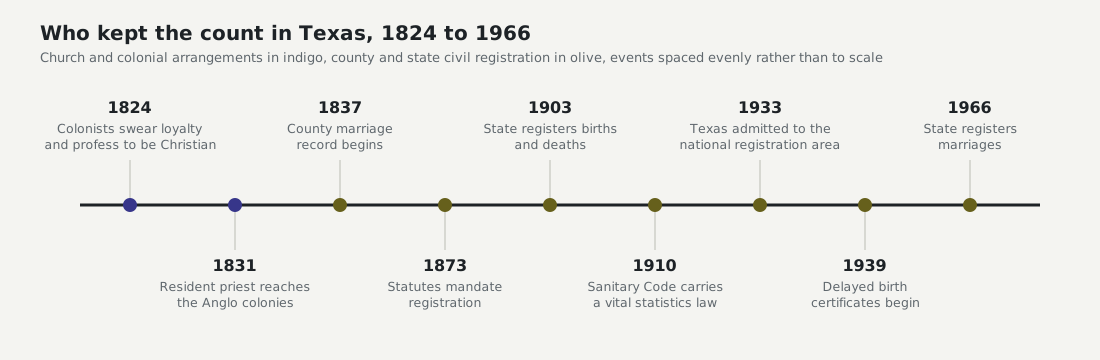
Paraphrased, the line runs like this: I swear loyalty to the Mexican nation, and I declare that I am a Christian. From 1824, when the Mexican Republic adopted its constitution, every immigrant to the colonies took an oath to that effect. The national and state colonization laws named no church. Because Catholicism was the religion the Mexican state recognized, though, the oath carried the implication that each settler would become a Catholic.1
That sentence is the right place to begin with church records in Texas, because it shows how tangled the sacrament and the state once were. A settler’s standing before the government, and with it his land, ran through a declaration about his faith. Whatever a priest later wrote in a register about that settler was written inside the same arrangement.
What the register was kept for
A parish register records a sacrament. In the registers I have read, a baptism entry states that on a given day a named person was received into the church, and it names the people who brought the child and the priest who performed the rite. As I read it, the book existed so that the church could know who belonged to it. A birth date is sometimes written in, and it is always secondary to the event the page exists to record.
For long stretches in Texas that was the only near contemporary record of a birth anyone made, and some of the Spanish and Mexican era registers have since been published. The state archives hold a published volume of annotated baptisms from San Agustín de Laredo covering 1789 to 1823, and microfilm of records from Nuevo León, 1701 to 1966, documenting births, baptisms, marriages and deaths on 380 reels.2
In the Anglo colonies the supply of clergy was the constraint. No priest lived among those settlers until 1831.1 Michael Muldoon, the only priest appointed to serve the non Hispanic settlers, was in Texas from April 1831 to August 1832, and colonists who accepted the Catholic faith nominally, in order to secure their land as the government required, came to be called Muldoon Catholics.3
So a baptism written in those months can record something other than a conversion or a birth. It can record a legal step taken by an adult who needed the entry for his title. I read the registers of that period the way I would read any document made to satisfy a requirement: the fact it records is the fact the requirement demanded, and the rest is incidental.
The arrangement did not last. Catholicism held its official standing until late in the Mexican era, then declined after the Revolution and stayed at a low ebb until enough Catholic immigrants arrived from Germany, Ireland and elsewhere.4 Many of those newcomers reached Texas by sea, a record problem of its own taken up in the essay on Galveston passenger lists. Every other congregation in the state kept its own books in its own way, or kept none.
Many family historians will think the next rule too strict. I do not write a baptism date as a birth date, even with the word about in front of it. A baptism proves that a child was alive on that day and was brought to a particular church by particular people. The gap between birth and baptism depended on the family, the season, the distance to the nearest priest and whether one was in the county at all, and in the Anglo colonies before a resident priest arrived in 1831 I can name no upper limit to it. The objection is a fair one: the baptism is usually close, the reader wants a year, and a researcher who refuses every approximation will leave most people in a narrative without a date of birth. I accept that cost. A reader can do more with a clearly labeled baptism than with a birth year I invented by subtraction.
The long wait for the state
The reason church registers matter so much is how long the state took to replace them. Legal requirements to register each person in Texas go back to the Mexican colonization laws, and statutes mandating registration were enacted in 1873, but the Handbook records that many decades passed before vital statistics were reported efficiently.5 The Department of Public Health and Vital Statistics took that name in 1903. In 1907 the state health officer began collecting statistics even though the legislature had not appropriated money for the work, and the Sanitary Code of 1910 carried a vital statistics law that was amended many times. Conditions remained unsatisfactory until 1933, when Texas was admitted to the national registration area.5
The state archives give the researcher’s version. Austin started registering births and deaths in 1903, the registration of births did not become reliable until the 1930s, anything earlier sits with a county clerk if it exists at all, and certificates filed late for people never registered at birth date from 1939.6 The county marriage record is older, dating from 1837, and it was the only official marriage record until the state began registering marriages in 1966.76
Set those dates beside a church register and the register’s value is plain. For a child born in 1880 in most Texas counties, a baptism entry may be the only paper made within the year. It is also the paper least likely to have been surveyed. When the Historical Records Survey, a federal relief program begun in Texas in 1936, worked through the state’s records, it prepared name indexes to more than four million birth, death and marriage records, but the inventory of church records it started got little done and was never published.8 The civil records got finding aids. The congregations’ books stayed where they were.
That leaves the method with two hard limits, and I have not solved either. The first is coverage. A register counts members of one congregation, so a county with three churches and no priest for half the year produces three partial counts and a silence, and the people most likely to fall into the silence are the ones who belonged to no congregation at all. The second is custody. In my experience a register is reached through a parish office or a denominational archive, on that institution’s terms and hours, and a published transcription is often the only version a researcher outside the church ever sees. I have cited a transcription more than once without seeing the book behind it, and my notes admit it each time.
The household version of the problem belongs to the companion piece on private registers, and the two records fail in opposite ways: the family knew the child but not always the date, and the church knew the date of its own act but not always the child. Methods for joining such records across a life are set out in one delegate traced through three sources. The Handbook compiled by the Texas State Historical Association supplied most of the dates in this essay, the state’s own guides at the Texas State Library and Archives Commission supplied the rest, and a working researcher’s reliance on both runs all through the Coke biography. The companion studies are listed under the archives section.
Which brings me back to the oath. A colonist declared himself a Christian because the government asked him to, and some later went to a priest because their land depended on it. The register that recorded the result is honest about the ceremony and silent about the belief, and the line that opened this essay is the reason I never ask a church record to tell me more than who was admitted, when, and by whom.
References
-
Handbook of Texas Online, Texas State Historical Association, Anglo American Colonization. ↩ ↩2
-
Texas State Library and Archives Commission, Mexican American Genealogy Research. ↩
-
Handbook of Texas Online, Texas State Historical Association, Muldoon, Michael. ↩
-
Handbook of Texas Online, Texas State Historical Association, Religion. ↩
-
Handbook of Texas Online, Texas State Historical Association, Public Health. ↩ ↩2
-
Texas State Library and Archives Commission, Texas Vital Statistics Indexes. ↩ ↩2
-
Texas State Library and Archives Commission, About County Records. ↩
-
Handbook of Texas Online, Texas State Historical Association, Texas Historical Records Survey. ↩