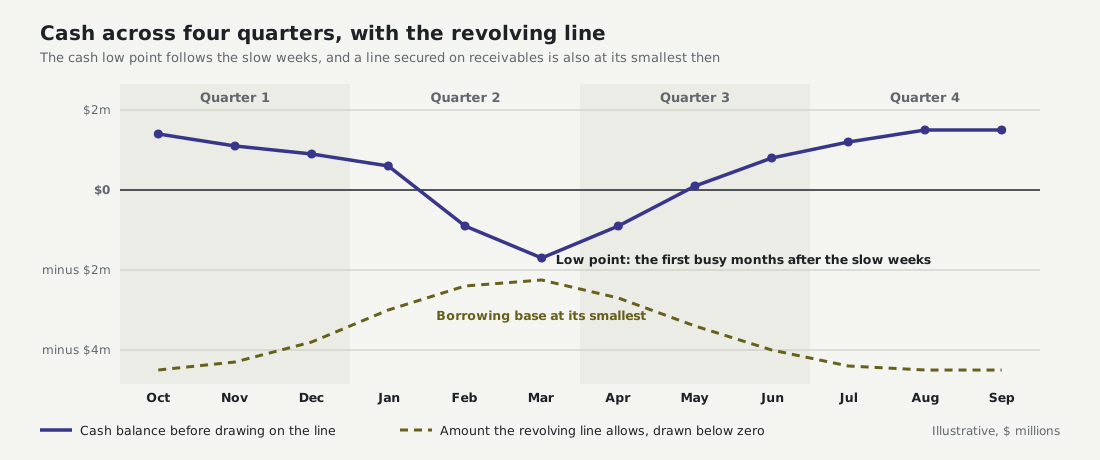
A new director asked me during a break in a board meeting which month of the year the company was most likely to run out of cash. We were standing by the coffee, the chief financial officer was fixing a projector cable, and the question sounded like small talk. I gave the answer almost everybody in energy services gives. The slow month, I said, the dead weeks around the holidays when operators stop spending and crews sit in the yard.
He shook his head. He had run a company in another seasonal business for years, and he said the slow month was never the one that hurt him. The one that hurt was the month the work came back.
We went back into the meeting and I spent most of the next hour looking at the company’s monthly cash balances for the prior three years, which were in the appendix and which nobody had discussed. He was right. The lowest balance in each of those years fell in the first busy month after the slow one, not in the slow one itself.
The month after the slow month
The mechanics are simple once you see them. In a slow stretch a service company does less work, so it pays for less fuel, fewer consumables and less overtime. Its receivables keep coming in from the busier months before, a few weeks behind. For a while the slow period can even look comfortable in the bank account, because collections from the good months are still arriving while spending has fallen.
Then the phone rings. An operator restarts a program, and the company has to answer at full strength. It calls back the hands it let go or sent home, pays them every week or two from the first day, buys fuel on delivery, restocks the shop, and puts trucks back on the road. None of that work turns into cash for two or three months, because it has to be ticketed, invoiced, approved and paid. Meanwhile the collections that carried the slow period have run out, since there was little work in the slow period to collect on.
So the trough in the cash balance lands after the trough in activity, and it lands deeper than the slow period alone would suggest. The company is spending at a busy rate while collecting at a slow one. Every owner knows this in his bones. Very few have it written on a chart in front of a lender six months before it happens.
Some of these rhythms are published. The gas market has a calendar so regular that the government describes it plainly: storage generally fills from April through October and draws down from November through March, mostly to meet demand for heating.1 The calendar of service work is less tidy and nobody publishes it, but it is just as real to a company that lives inside it, whether the cause is a February freeze in a basin much of which lies beneath the high ground of the Llano Estacado,2 an operator’s budget running dry in the fourth quarter, or a slow restart in January while new programs get approved.
Why the borrowing base shrinks on schedule
This is where seasonality stops being an operating question and becomes a financing one. Most revolving lines for service companies lend against eligible receivables, a percentage of invoices under a certain age. That structure is sensible, and it has a feature that owners notice only once. The borrowing base follows receivables, receivables follow activity with a lag, and so the amount a company can draw is lowest at exactly the point in the year when the restart needs it most.
Put illustrative numbers on it. A company that bills $4 million in a normal month might carry $6 million of eligible receivables and have a borrowing base of about $4.5 million. After a slow quarter billing half that, eligible receivables might fall to $3 million and the base to about $2.25 million. That is the moment the company needs to fund six weeks of restart payroll and fuel. The line was never cut. It shrank on schedule, by design, and nobody at the table had drawn the calendar.
Paying for money you hope not to use
My position follows from that, and I know directors who think it wasteful. A seasonal service company should size its committed facility to the worst restart month in its own history, plus a margin, and should pay the unused fee on that capacity all year. It should arrange that facility in a strong quarter, when the numbers look their best and the lender is comfortable, and never in the slow one, when every request reads as distress.
The case against is familiar. Commitment fees on an idle line are real money, paid every quarter for nothing visible. A company that keeps a large undrawn line can grow careless, and some directors would rather see management hold a cash reserve on the balance sheet or cut costs harder in the slow months. There is also an argument for equity, and I hear it often: put in enough growth equity to carry the trough and be done with bank covenants. To my mind that is the most expensive possible answer to a problem that recurs on a calendar. Permanent capital should fund permanent needs. A gap that opens every January and closes every April is a borrowing problem, and paying equity prices to solve it gives away ownership to cover a timing difference.
The idle fee buys something specific. It buys the ability to answer the phone at full strength in the first busy month, which in this business is often when the best work of the year gets awarded, to the companies that can show up.
Where the pattern lies
I have trusted the pattern too much. I once helped size a line for a company whose three years of monthly cash had drawn the same shape so cleanly that the board accepted it without much argument. That year the slow quarter did not end on time. The restart we had planned for came about ten weeks late, and it came in pieces, one operator at a time. The line we had arranged was sized for a deep, short trough, and what arrived was a shallow, long one. We covered it, but only by asking the lender for a waiver we had never expected to need, in exactly the kind of month when I had said nobody should be asking a lender for anything.
The lesson I took is that the history of a company’s cash tells you the shape of an ordinary year and very little about an unusual one. A director without control over the company can still ask to see the monthly cash for five years, which is one of the few things any seat can insist on, and I discuss what else such a director can ask for in the essay on minority board seats. The same season that squeezes cash also crowds the claims file, and it is one reason I ask about insurance early. The ground itself is described in the entry on the Permian Basin. Drawing the calendar is a habit I carry into my board work, and it shapes the energy essays more broadly. Capital following the calendar of the fields is older than any company I have known, which is one reason I keep reading the history of Dallas and its oil money.
I still believe in drawing the calendar. Five years of monthly cash will show a board where the low point falls and roughly how deep it runs. What that record still cannot say is when the next slow quarter will end, and the line is there for the year it ends late.
References
-
U.S. Energy Information Administration, Factors affecting natural gas prices ↩
-
Texas State Historical Association, Handbook of Texas, Permian Basin ↩