The room went quiet when I asked whose name belonged next to line forty one. We were two weeks from closing the purchase of a smaller service company, a competitor working the same operators out of a yard a few hours away, and the acquisition model had been through a dozen drafts. Line forty one read integration costs, one time, with a figure of $250,000 spread across two quarters. It covered software licenses, some consulting, a little severance. The chief executive looked at the chief financial officer, who looked at the deal adviser, who looked at his notes.
Nobody had a name, because the line had never been meant to hold one. It had been built to hold a number, and the number was the least important thing about it.
That line appears in nearly every add on model I have read, and it measures the wrong thing. Integration does cost money, and $250,000 may even be about right for the checks that get written. The expensive part never shows up as a check. It is the time of the people who run the first company, spent for a year or more on questions nobody at the table has yet listed, and when that time is not assigned to one person it gets taken from everyone, a little at a time, out of the hours that were supposed to run the business that already existed.
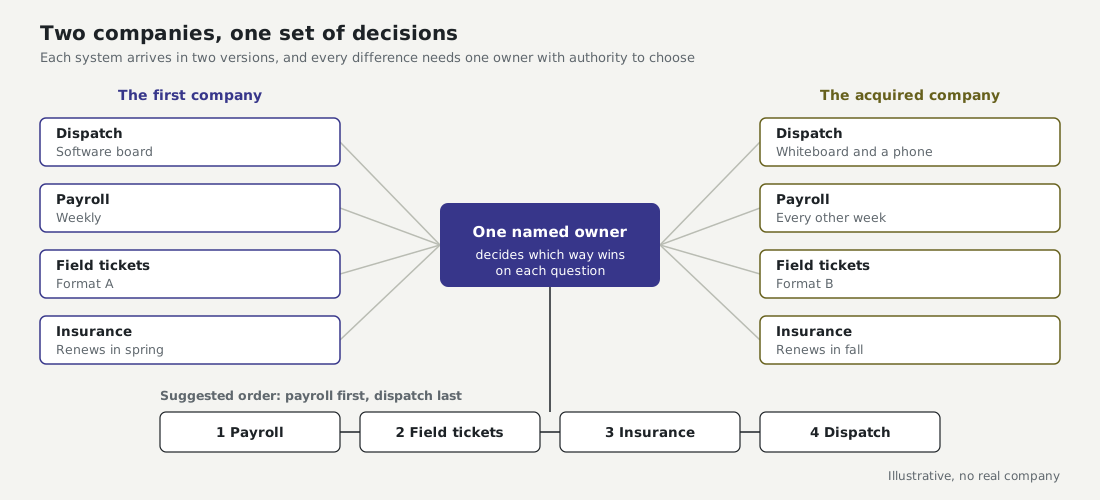
Consider what actually arrives on the first Monday after closing. Two dispatch boards, one run in software and one run on a whiteboard and a cell phone by a man who has known the same company men for fifteen years. Two payroll cycles, one weekly and one every other week, with different overtime habits and a different idea of when per diem gets paid. Two ways of writing a field ticket, two sets of operator approval portals, two receivables books with their own payment habits, which I have written about in what the receivables report says about power. Two insurance programs renewing in different months, one of the first things I look at for reasons I set out in why I ask about insurance early.
Every one of those differences is a decision. Which dispatch system survives. Which pay cycle. Whose ticket format, whose safety manual, whose shop foreman runs the combined maintenance schedule. None of these is hard on its own. Together they amount to a second job, and a decision without an owner does not stay open. It gets made by default, usually in favor of whoever complains loudest, and the acquired company’s people learn in their first month that the loudest voice wins.
So my position is simple and, I have found, unpopular. Before closing, the board should name one person who owns the integration, give that person the authority to decide which way wins on each of those questions, and relieve that person of enough of the regular job to do it. I would rather see the chief executive hand a piece of his own work to a deputy for a year than see him try to run two companies from one calendar.
The second half of my position draws more argument. I would harmonize payroll first and dispatch last. The efficiency case runs the other way, since combined dispatch is where the savings in the model come from. But crews judge a new owner by the first paycheck, and a botched pay cycle loses people in a week. Dispatch is where the acquired company’s customer relationships actually live, in that man with the whiteboard, and moving it early is the quickest way to find out which operators were loyal to him rather than to the company.
The objection deserves a fair hearing. A single integration owner can become a bottleneck, and every decision routed through one desk slows down. Some directors would rather let the two operations run side by side for a year, change nothing, and learn before they merge anything. There are cases where that is right, particularly when the acquired company is in a different basin and serves different customers.
My own rule has failed me in the other direction. I once backed an integration lead who was careful, thorough, and slow. Every question went into a matrix, every matrix went to a meeting, and the acquired company’s best dispatcher, waiting three weeks for an answer about his own truck allowance, took a call from a competitor and left. The integration plan was excellent. The man it was meant to keep was gone before it finished. I still do not know the right pace, only that a named owner moving too slowly is a problem you can see and fix, and nobody moving at all is a problem you learn about from the customers.
Money for an add on often comes as growth equity, and the investment memo that supports it usually describes the purchase in detail and the eighteen months after it in a paragraph. In the boards I have sat on the second company has taken more of the first company’s attention than any memo predicted, every time. Combinations make good history because the result is visible, the way the oil money that built Dallas is visible in its buildings. The work of joining the pieces leaves far fewer records, which is part of why it gets underestimated.
It is a theme in the other essays in the energy section. One company’s worth of habits is hard enough to manage. Two is not twice as hard, because the habits argue with each other.
The operators these companies serve keep their own public record of activity; the Railroad Commission of Texas publishes monthly drilling, completion and plugging summaries.1 Nothing comparable exists for the inside of an acquisition. The board has to build that record itself, and it starts with a name on line forty one.
The integration line should carry a person’s name, because the real cost is a year of that person’s attention, and it gets paid whether the model counts it or not.
References
-
Railroad Commission of Texas, Oil and Gas Research and Statistics ↩