An operator in the early upper Gulf Coast fields said, in substance, that fire was a constant danger and a steady cause of worry. The Handbook of Texas preserves his remark, and records beside it that drillers and producers in that area tried to set field rules of their own, chiefly about preventing fire.1 I have always read it as a note about timing. The rules were worth most before the first fire, and the operators knew it, and still most such rules get written the morning after.
I thought of that line in a board meeting in May, listening to an audit partner explain why a company’s first audit would be late.
The meeting in May
The company was a healthy one. It had grown for several years, taken on a new bank facility the previous summer, and signed, among forty pages of other provisions, a requirement to deliver audited annual statements within 120 days of year end. Until then it had never had an audit. A local firm had reviewed its books each year, and the owner and his controller had always found that sufficient, because nobody outside the company had asked for more.
The audit firm was engaged in January. By May the partner was sitting at the end of our table with a list. The fixed asset register carried eleven units that had been sold or scrapped over the prior four years and never removed from the books. Parts inventory had not been counted at year end, so it had to be counted in March and rolled back to December, which the audit team did not like and priced accordingly. December revenue included field tickets for work finished in the last week of the year and invoiced in January, and in some cases the reverse, so the cutoff had to be tested ticket by ticket. And because there had never been a prior audit, the opening balances for the year were themselves unaudited, which meant the firm had to reach back into the year before to satisfy itself that the starting figures were sound.
None of it was fraud, or even unusual. It was the ordinary sediment of a company nobody with authority to ask for everything had ever examined.
The partner expected to sign around day 150. The chief financial officer had already called the bank. The bank granted a waiver, for a fee and a tighter reporting schedule over the following year, and the lending officer, who had been friendly until then, began asking for things he had never asked for before.
Why the first one costs the most
Most owners picture an audit as a check of the year’s numbers. The first one is really a check of every year before it, compressed into a few months, because the auditors cannot rely on anything they did not see built.
So the first audit is the slowest and dearest the company will ever have. The fixed asset register has to be matched to the yard, serial number by serial number, and in a service company that has bought and sold equipment for a decade the two lists always disagree. Inventory has to be counted by people who have never counted it for an outsider. Revenue recognition, which the controller has handled by habit, has to be written down as a policy and then tested against that policy. Each of those tasks is modest in a company that has done it before and substantial in one doing it for the first time under a deadline somebody else set.
The deadline is what turns cost into damage to a relationship. An audit arriving on time is an administrative event. One arriving late, against a covenant, is a conversation with a lender about whether the company knows its own numbers, and in my experience that conversation colors the next several.
A year before anyone asks
My position is that a growing private company should pay for its first full audit at least one year before any lender, buyer or new investor requires one, and should treat that first audit as a rehearsal whose findings nobody outside the company sees.
Plenty of experienced directors think that wasteful, and the argument against me is not a weak one. A review by outside accountants gives most private companies what they need at a fraction of the price. In a hypothetical company of this size, a review might cost $30,000 and a first audit $120,000 or more. Spending the larger figure a year early buys a document nobody has requested, about a year that will be irrelevant by the time anyone does request one. It also eats the controller’s busy months. Why pay to find trouble early, the argument goes, when you could fix the books quietly and let the real audit find less?
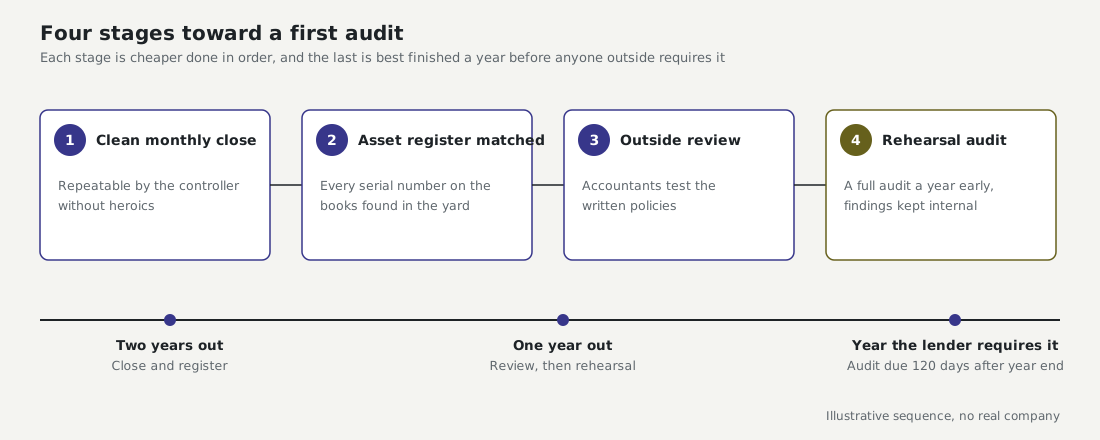
My answer is that nobody fixes books quietly. Companies intend to, and then the busy season arrives. The rehearsal audit is the only method I know that forces the four pieces of preparation to happen in order: a monthly close the controller can repeat without heroics, a fixed asset register matched to the physical yard, a review that tests the policies, and then a full audit while the stakes are still internal. The diagram above sets out that sequence. A company that has done all four enters its first required audit with opening balances already examined, and that alone takes months off the timetable.
Outside capital also changes who reads the numbers. A business that takes growth equity will be read by a board, a lender and eventually a buyer, each wanting figures on a date, and an owner who has never been audited underrates how it feels to be asked, formally, for everything. The rehearsal lets him learn that in private. It matters especially when several companies are being put together, since combined books arrive with every weakness of each, a point I make in the essay on why a roll up disappoints. It matters too when a founder steps back from running the company, because the new chief executive inherits whatever the founder never wrote down, a transition I take up in what changes when the founder moves to the chair.
Where my rule cost more than it saved
I have pushed this advice on companies where it did not pay. In one case I persuaded an owner to commission an early audit, and to save money we chose a small local firm that did very little energy work. The audit came back clean. A year later a new lender, reviewing the company for a larger facility, insisted on a firm with more experience of oilfield companies, and the new firm reopened a good part of what the first had accepted, including the treatment of equipment the company had rebuilt rather than bought. The owner paid, in effect, for one and a half first audits. He was polite about it. He was also right that my advice had cost him money, and I would now tell an owner to choose the firm the next lender will accept, even at a higher price.
The rule has a weaker spot as well. An early audit tests the systems a company has today, and fast growing companies replace their systems. A clean audit on one accounting platform says less than it seems to about the year after a migration to another. The rehearsal helps. It cannot promise the performance.
Reading a company’s numbers against a calendar is a habit energy finance gave me early, and my career since has only hardened it. The producers worrying about fire on the Gulf Coast belong to the same long story that a history of the city’s oil money follows north to Dallas. The same habit shows up across my essays on energy businesses.
The company in May recovered. Its second audit came in on day 95, and the lender’s tone improved around the same time. Of all the figures in that first audit, with its eleven phantom units and its recounted parts, the one that mattered was 120, printed on page thirty one of a credit agreement that nobody at the company had read closely until the day it was missed.
References
-
Texas State Historical Association, Handbook of Texas, Oil and Gas Industry ↩