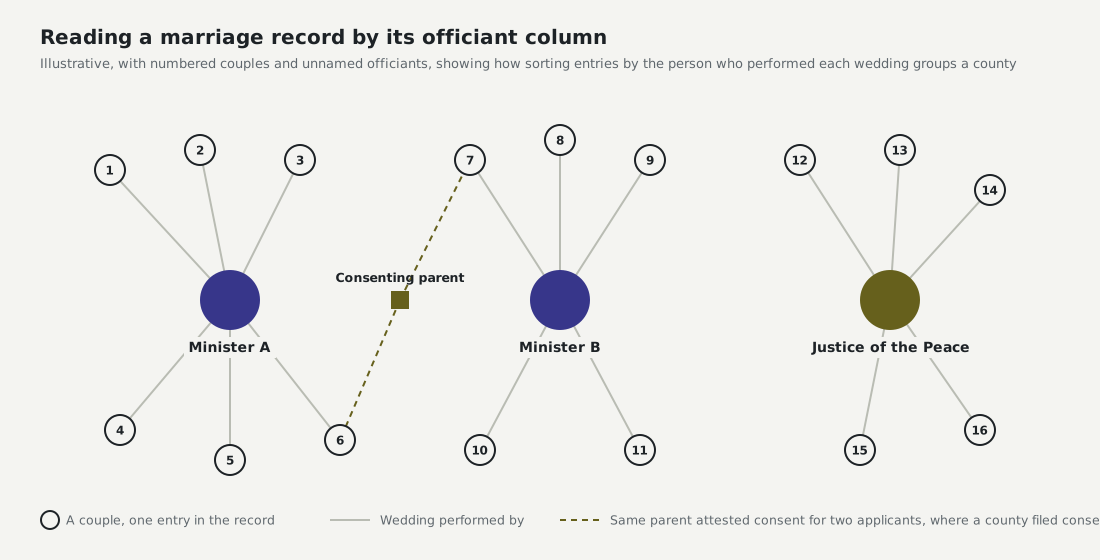
The question came from a man at the far end of a reading room table, who had watched me turn the leaves of a county marriage record for most of an afternoon. He wanted to know what I could possibly be hunting for, since the index already told me who had married whom. I said I was reading the other column.
That answer needs unpacking, and the unpacking is the whole case for this record.
What the clerk was told to write
The marriage record is the oldest of the vital records a Texas county clerk keeps, and the state archives date the series from 1837.1 The law behind it asked for two entries at two moments. When the clerk issued a license, he recorded it. When the license came back to his office, he recorded the date of the ceremony and the name of the person who had performed it.1 Until 1966 no office at the state level registered marriages at all; the only record lived with the clerk of the county where the license was taken out.2
The requirement to have someone with authority do the marrying is older than the book. Under Mexico the Catholic Church was the established religion, there was no provision for a civil ceremony, and only priests could perform nuptial rites. Settlers who could not reach a priest were allowed to sign a marriage bond promising to formalize the union when one arrived, and the church did not send a resident priest into the Anglo colonies until 1831.3 Later, a law permitting couples to record proof of marriages made before the Republic produced a separate marriage bond record in a few counties.1
So the page was built for a narrow job. It proves that the county permitted a marriage and that a named person reported performing it. Everything else a researcher takes from it is a byproduct.
The column that draws the map
The byproduct I want is the officiant. Every completed entry carries a name, a minister or a justice of the peace, and a county’s volumes over ten years amount to a complete list of who married its people under license. Sort the entries by that name instead of by the couple and the record turns into something else entirely: a map of which households went to which preacher, which went to the courthouse, and which families kept the same minister across a generation.
I know of no other record of the period that does this for an entire county. A church roll covers one congregation, if it survived at all. A wedding notice in the paper covers the families who wanted one printed. The marriage record covers everyone who married under a license, because the law sent every one of them past the same counter.
Careful genealogists dispute the next part of my practice. On a first reading of a county’s volumes I skip the couples and tally the officiants, and I will not draw a conclusion about any single marriage until I know which ministers were active that decade and roughly how many weddings each one performed. The objection is fair. The point of the record is the couple, and a tally of preachers can eat a week. My reply is that one entry means little until I know its neighbors. A wedding performed by a justice in a county where nearly everyone else went to a minister says something about that couple. The same wedding in a county where half the entries carry a justice’s name says almost nothing.
The tally also dates things that nothing else dates. A minister’s name appears in the volumes when he arrives in a county and disappears when he leaves or dies, so the run of his entries brackets his years of service more tightly than most church histories do. When a younger man starts marrying the children of couples an older minister married twenty years earlier, the record has caught a succession in a congregation that may have kept no minutes.
The map sharpens where a county wrote down more than the officiant. Formal application procedures were not promulgated by the state until 1959, but some counties used applications by custom before then, and some filed attestations from parents testifying to the age of a young applicant and giving consent.1 Those papers put a father or a guardian on record beside the couple, and two consents from one household a few years apart tie families together in a way a census taken once a decade never does. The residence columns of 1867 do something similar for a man’s arrival, as the ledgers of registered voters show, and the two records join well.
Where the map goes blank
Now the limits, and they are serious.
The first is the clerk’s own habit. Beginning in the 1890s many clerks used receipt stub books and stopped recording licenses when they were issued, making an entry only when a license came back. In most counties, as a result, the record holds only the licenses that ended in a marriage, and most of the stub books have not survived.1 A license taken out and never used, which can tell a story of its own, has usually left no trace.
The second is that the county divided its own people on paper. In some counties, especially during Reconstruction, the marriages of Black couples were recorded separately, in a series the state archives list as the freedmen’s marriage record.1 A tally built from one series maps part of a county and presents it as the whole. I have made exactly that error. I worked through a volume I believed was complete and formed a view of one minister’s reach that the companion series would have changed, and I found the second series only because a microfilm guide listed two titles where I had pulled one.
The third is that the map shows who performed a ceremony, not who belonged where. A minister married whoever asked him, including neighbors outside his church, and a justice married couples whose own preacher was away. The record is evidence about the person with the authority. Membership needs a second source.
The fourth is physical. The film I usually read was made from the county volumes between the 1970s and the early 1990s, and not every county, nor every series within a county, was filmed.4 The state archives also warn that nineteenth century iron based inks can chip away and leave a faint reddish brown ghost of the writing.4 An officiant’s signature is usually the last line on an entry and the first to fade.
For all that, the county marriage record has carried more of my work than several records with better reputations. The ordinary lives behind the Coke biography were built from county paper of exactly this kind, and the habit of joining one name across several such records is shown step by step in the study of a single convention delegate. The reels are described in the county guides of the state library and archives, and a county’s newspaper, where one has been digitized through the Portal’s newspaper program, can sometimes supply the wedding notice the record leaves out.5 Records that reward the same patience sit together under the archives heading.
So my answer to the man at the table stands, with a list attached. The next time a county marriage record is open in front of you, read the officiant column before the couples. Count the justices against the ministers. Ask whether the county kept a second series. Find out whether the clerk recorded licenses or only completed marriages. And look hard at the ink before trusting a faded name.
References
-
Texas State Library and Archives Commission, About County Records. ↩ ↩2 ↩3 ↩4 ↩5 ↩6
-
Texas State Library and Archives Commission, Texas Vital Statistics Indexes. ↩
-
Handbook of Texas Online, Texas State Historical Association, Anglo American Colonization. ↩
-
Texas State Library and Archives Commission, County Records on Microfilm. ↩ ↩2
-
The Portal to Texas History, University of North Texas Libraries, History of the Portal. ↩