Read aloud, the result sounds like a verdict: 44,689 to 11,440. That was the margin by which the radicals carried the election on calling a new constitutional convention, the vote that put the delegates of 1868 into the hall in Austin that June.1 I have heard the figure offered as proof of two opposite things.
The problem sits inside a single paragraph of the Handbook of Texas. One sentence says that most conservatives did not bother to register or to vote. Three sentences later the same paragraph says that, contrary to the old argument that they had been disfranchised, most of them registered, and only a little more than half of the registered whites cast ballots.1 Both statements may be true of different counties. They cannot both describe the state, and anyone writing about the politics of the following decade has to know which one to believe.
The record that can answer part of the question is the voter registration lists compiled between 1867 and 1870 under the Texas Secretary of State. They list the qualified voters of each county who could take part in the election of the convention.2 The state archives describe the ledgers as the only comprehensive listing of eligible voters it holds, and they note that ordinary registration was a county business, so later lists live in county offices if they survive at all.2 The politics around them are summarized in the entry on Reconstruction in Texas.
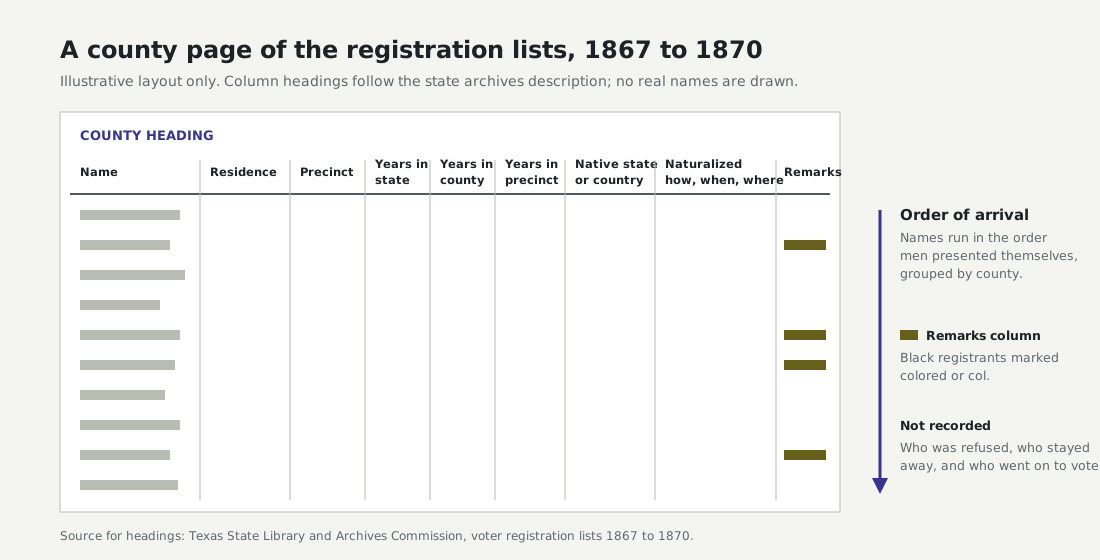
What the ledger was built to do is narrow. Congress had required that delegates be chosen by every adult male citizen regardless of race or former condition, with felons and men disqualified for their part in the rebellion shut out.1 Registration was the step that established, man by man, who stood inside that rule. So each entry records a name, a place of residence, a precinct, the length of residence in the state, the county and the precinct, the native country or state, and, for a naturalized man, how, when and where he was naturalized.2 A remarks column marks black registrants as colored.2
Two features of the format matter more than any single column. The entries are grouped by county, and within a county the names run in the order in which men presented themselves.2 The ledger is a queue. Read down a page and you are reading a sequence of mornings.
The second feature is what the page leaves out. Nothing in the described format records a man who came forward and was refused.2 The list counts arrivals who qualified. It is silent about the disqualified, the unwilling, the absent and the dead, and those four groups are exactly what the argument over disfranchisement is about.
So my method runs in three passes. First I count a county’s entries by the remarks column, which gives me the black and white registrants separately. Then I set that count beside the county’s election returns for the convention vote, when I can find them, because the ballots are the numerator and the register supplies the denominator. Only then do I read the names, looking for the men I already know from tax rolls and newspapers, and noting who is missing.
A missing man is where judgment enters. My rule is that absence from the register proves nothing about disqualification. A man who does not appear may have been refused, may have declined, may have moved, or may be sitting under a misspelled name three pages on. I will not write that a named Texan was disfranchised on the strength of a gap in this ledger. An experienced researcher could fairly argue that a prominent Confederate missing from his home county is disqualified in all probability, and that my rule throws away a strong inference. I would rather lose the inference than print a guess about a named person.
The residence columns earn their keep for a different reason. Years in the state, in the county and in the precinct are three numbers a man gave about himself, and together they bracket his arrival. When that bracket agrees with a deed or a marriage entry, as the essay on county marriage books describes for a different ledger, the join between records gets stronger. When it disagrees, I trust the deed. Nobody checked a registrant’s memory of the year he crossed the Sabine.
The finding aid carries its own cautions. The counties are not filed in strict alphabetical order, some sit on more than one reel, Cass registrants are to be sought under Davis, and one page is marked for Jack and Young counties together.2 Every one of those notes is a place where a careless search comes back with nothing and a researcher concludes a county was empty.
I also have to admit what I actually read. The images online were made from the reference microfilm, not from the ledgers.2 The state library issued the 1867 registers on microform, among other publications of its archives.3 What I have handled is a photograph of a photograph, and whatever the bindings, inks and later annotations might tell a reader of the volumes themselves has not reached me. The ledgers are held by the Texas State Library and Archives Commission, and anyone making a strong claim about a single entry should ask to see the original.
Where does that leave the paragraph with two answers? County by county, the register can show how many white men came forward, and the election returns can show how many of them voted. That settles turnout among the registered, which is the Handbook’s second claim. It cannot settle how many never presented themselves at all, which is the first, because a man who never came leaves no line. I have come to think that is the most important thing to know about any roll of names, the same caution I apply to the three records in tracing a delegate and to the survey lines in the essay on land office maps. The work on my biography of Coke leaned on that caution more than once, and the rest of these record studies are collected in the archives hub.
The figure read aloud at the start was a count of ballots. The ledger is something smaller and more exact. Each line is a man who walked up to a table in 1867 or 1868, said where he lived and how long he had been there, named the state he was born in, and waited while a clerk wrote it down in the order he arrived.
References
-
Handbook of Texas Online, Texas State Historical Association, Reconstruction. ↩ ↩2 ↩3
-
Texas State Library and Archives Commission, Texas Secretary of State voter registration lists, 1867 to 1870. ↩ ↩2 ↩3 ↩4 ↩5 ↩6 ↩7 ↩8
-
Handbook of Texas Online, Texas State Historical Association, Texas State Archives. ↩