Three days before the vote, a correspondent at Karnes City told the readers of a San Antonio paper that the county was taking a lively interest in Thursday’s election to remove the seat from Helena. The point of the change, he wrote, was to put the county seat somewhere more central, and the people of his own town were sure they would get it. Three towns were in the running: Karnes City, Kenedy and Helena. He expected a very hot contest.1
That dispatch is where my research problem starts, because by the time the results were printed one of those three towns had vanished from the count and a different one had taken its place.
The dispatch and the count
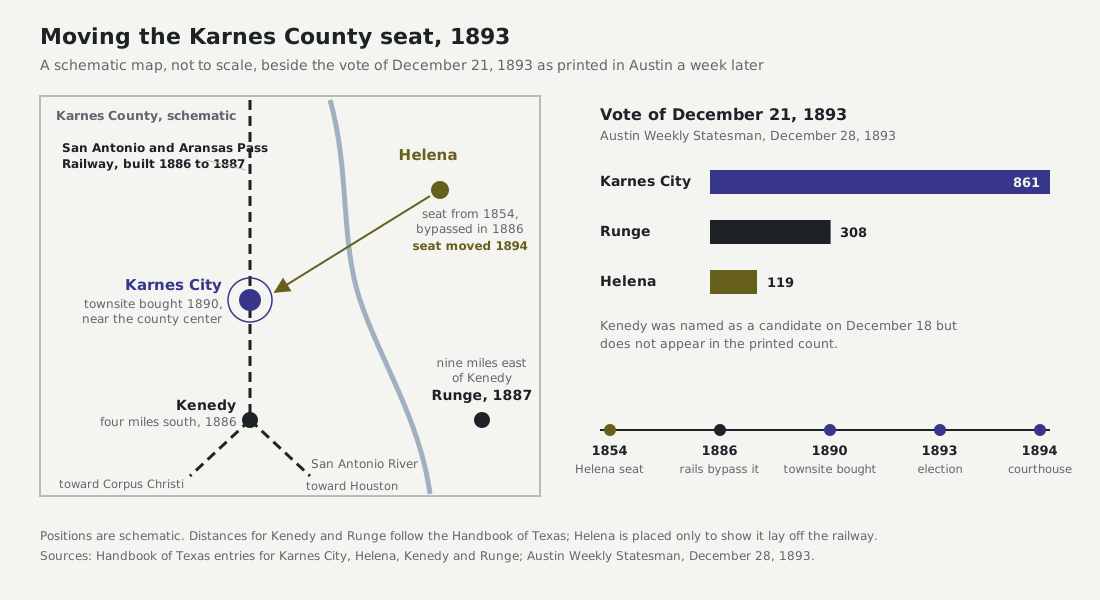
The Austin Weekly Statesman printed the result a week later, under a Karnes City dateline of December 21, 1893. Karnes City had 861 votes, Runge 308 and Helena 119, and the paper noted that Karnes City had won by two thirds of all votes polled and five over.2 Kenedy does not appear. Runge, which the December 18 dispatch never mentioned, came second.
The Houston Daily Post for December 22 helps a little. A Runge correspondent reported that the election passed off quietly there, and a Kenedy correspondent described the contest as one between Karnes City, Helena and Runge, adding that Karnes City had about four fifths of the vote outside the Runge box.3 By election day, then, the Kenedy man himself was not describing his town as a candidate.
A fourth town in the Handbook
The Handbook of Texas, the reference work published by the body described in the entry on the Texas State Historical Association, says Karnes City won the December 21, 1893, election over Runge, Kenedy and Helena.45 That is a fair summary of everyone who was ever in the field, and a slightly misleading summary of the ballot as counted. My judgment is that Kenedy was a candidate in mid December and had dropped out or been dropped by the 21st. I cannot yet say which, and I write it that way.
The Handbook adds a detail no dispatch I have read contains: in January 1894 the contested records were carted to Karnes City by night. Prisoners and jail cages followed in March, and the new courthouse was dedicated on October 25, 1894.4 Helena’s courthouse became a school.6
What the railroad had already decided
The vote looks like the start of the story. It was closer to the end. The San Antonio and Aransas Pass Railway was built through the county in 1886 and 1887.4 Helena, the seat since 1854, was bypassed in 1886 after its citizens refused to raise money to bring the line through town. The Handbook repeats a local legend that a rancher whose son was killed in Helena gave the railroad its right of way elsewhere, and it labels that story as legend.6 Kenedy grew up on the railway in 1886.7 Runge dates from 1887 and was the county’s largest town by 1890.8
Karnes City was built for the purpose. In December 1890 a group of Cuero businessmen bought a 1,000 acre tract near the geographic center of the county, astride the railway, to plot a townsite that could become the new seat. Lots were auctioned in May 1892.4
People who like these stories for their gunfire will object to my view of them. Most Texas county seat fights were settled by whoever owned a townsite on the railroad, and the election ratified a decision the investors had already made. Groveton fits: voters chose it in 1882, when it had rail facilities, sat nearer the center of Trinity County and was offered a square and building materials by the lumber company auctioning its lots.9 So, in a different way, does Fort Worth, which aided its cause in Tarrant County’s 1860 election by promising to build a permanent courthouse.10 The quarrel over the stone for that later building is in the essay on quarries and freight.
Earlier fights, same shape
Not every contest was settled that cleanly. Dallas County’s first vote for a permanent seat, in 1850, gave Dallas 191, Hord’s Ridge 178 and Cedar Springs 101; Dallas won the runoff over Hord’s Ridge, 244 to 216.11 Birdville lost to Fort Worth by seven votes in November 1856.12 Acts of violence followed that election, its result was declared invalid, and another vote in April 1860 settled the matter.10 The Handbook’s general article says flatly that county seat wars were common during the settlement of Texas.13 The buildings that winners put up are surveyed in the reference entry on Texas county courthouses, and the commissioners court that ran them is described in a study of county government after 1876.
Sometimes the fight barely started. The Hood County commissioners briefly considered moving the seat from Granbury to Thorp Spring before commissioning a new courthouse there in 1890,14 and Thorp Spring was bypassed by the railroads that crossed the county in that decade.15
Two thirds and five over
The method has a weak joint, and I should name it. A newspaper tally is the reporter’s count, telegraphed on election night or copied from a clerk. The Statesman’s figures add to 1,288, and I have no official canvass to check them against. A later Houston report lists the vote box by box, but the scan is too damaged for me to trust a single figure, and one garbled line in it may allege irregular votes at Helena.16 I will not build anything on a line I cannot read.
Records like these sit behind the courthouse dedications I attend, as my civic page explains, and the stone a courthouse was dedicated with is taken up in the essay on reading a cornerstone. Other pieces on these buildings are gathered on the courthouses index.
The record still cannot tell me why the Statesman’s correspondent measured the win against two thirds. It may be that the law of 1893 set that threshold for this removal, or that he was answering a rumor that Karnes City would fall short. I have not yet read the statute in force that December, and until I do, the phrase stays in my notes as he wrote it, a number with its reason missing.
References
-
San Antonio Daily Light (San Antonio, Tex.), December 18, 1893, page one, Chronicling America, Library of Congress, San Antonio daily light, December 18, 1893. ↩
-
The Austin Weekly Statesman (Austin, Tex.), December 28, 1893, page one, Chronicling America, Library of Congress, The Austin weekly statesman, December 28, 1893. ↩
-
The Houston Daily Post (Houston, Tex.), December 22, 1893, page two, Chronicling America, Library of Congress, The Houston daily post, December 22, 1893. ↩
-
Handbook of Texas Online, Texas State Historical Association, Karnes City, TX. ↩ ↩2 ↩3 ↩4
-
Handbook of Texas Online, Texas State Historical Association, Texas State Historical Association. ↩
-
Handbook of Texas Online, Texas State Historical Association, Helena, TX. ↩ ↩2
-
Handbook of Texas Online, Texas State Historical Association, Kenedy, TX. ↩
-
Handbook of Texas Online, Texas State Historical Association, Runge, TX. ↩
-
Handbook of Texas Online, Texas State Historical Association, Groveton, TX. ↩
-
Handbook of Texas Online, Texas State Historical Association, Tarrant County. ↩ ↩2
-
Handbook of Texas Online, Texas State Historical Association, Dallas County. ↩
-
Handbook of Texas Online, Texas State Historical Association, Birdville, TX. ↩
-
Handbook of Texas Online, Texas State Historical Association, County Courthouses. ↩
-
Texas Historical Commission, Hood County Courthouse. ↩
-
Handbook of Texas Online, Texas State Historical Association, Thorp Spring, TX. ↩
-
The Houston Daily Post (Houston, Tex.), December 24, 1893, page two, Chronicling America, Library of Congress, The Houston daily post, December 24, 1893. ↩