When I walk onto a courthouse square in Texas, I look for the cornerstone before I look at the tower. In my experience it sits low on a front corner, at the height of a man’s knee or his belt, and people walk past it on the way to pay their taxes without turning their heads. It is the one part of the building that carries a date on purpose, cut there by people who expected someone to read it.
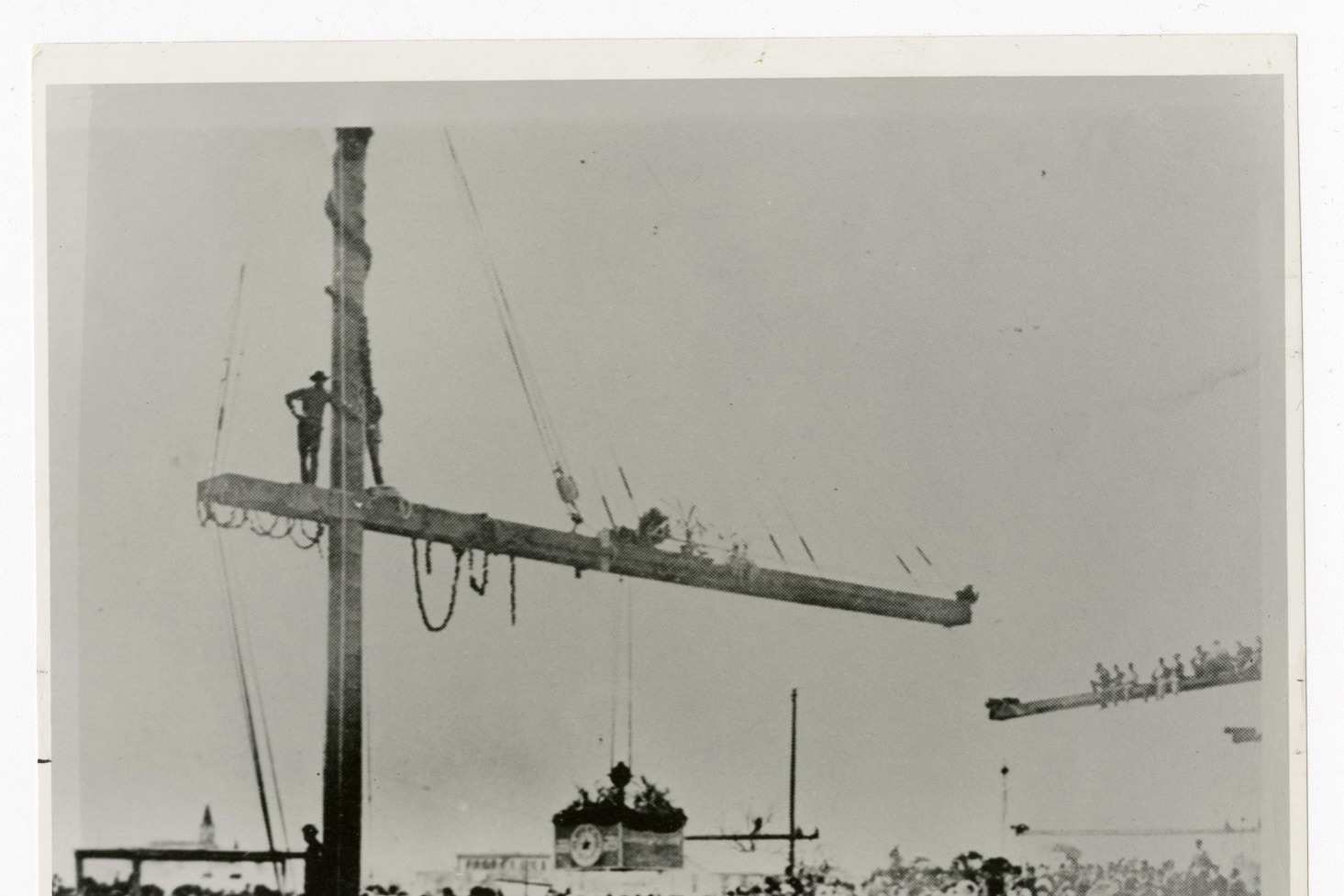
I have learned to distrust that date, and the record that taught me is a photograph in which the stone itself cannot be found: the laying of the cornerstone of the Texas Capitol in Austin on March 2, 1885, now in the collection of the State Library and reproduced at the head of this page.
What the picture shows
Start with what is in the frame, because the frame is the evidence. The lower half of the picture is a crowd so dense that individual faces blur into a field of hats. Near the center, men wear light colored sashes across their coats, and many in the foreground wear white aprons. A flag with a single star hangs on the left. Above the crowd rises a tall timber mast with a heavy boom swung out to the right, chains and tackle hanging from it, and two men stand on the boom near the mast. A second boom at the right edge of the picture holds a row of spectators sitting along it. In the middle distance is a draped stand or platform with a round star emblem on its face and greenery on top.
What the picture does not show is the stone. I have looked for it in every part of the image and cannot pick it out from the crowd and the rigging. There is no inscription to read, and I will not guess at one.
A newspaper fills in some of what the lens missed. The San Marcos Free Press, writing that Thursday, called the Monday of the ceremony a great day in Austin. It reported an estimate of 20,000 people present, with the Masonic fraternity out in force. The Reverend H. S. Thrall gave the prayer, Governor Ireland gave an address, other speakers followed, and the stone was laid by the Masons. The paper described the stone as a large block of granite with its center cut out to receive a box of mementoes of the times, which it called the usual practice on such occasions.1 Thrall was a Methodist minister and a historian who had preached in the old Capitol in 1846.2 The white aprons in the foreground fit the report that the Masons laid the stone, though the picture by itself does not tell me who wore them.
The dedication speech that day came from George E. Quinan of Wharton County, a former state senator and judge, and the Austin Weekly Statesman printed his closing remarks that week.34 Near the end he asked that the new walls rise “on the strength of granite and enduring marble.”4
Here is what makes the record valuable, and what makes the date on any cornerstone suspect. In March 1885 the building’s material was not settled. The plans had called for native limestone; the limestone near Austin was discolored by iron, the contractor proposed Indiana limestone, and the Capitol Board and the governor wanted the red granite of Granite Mountain. Only on July 25, 1885, did the contractor sign the supplementary agreement to build in that granite.5 The San Marcos editor, writing in March, said most people at the ceremony wanted the building finished in Texas granite, and that the people of the state would rather bear the extra expense than see it built of anything else.1 The Handbook credits Ireland with insisting on pink Texas granite over Indiana limestone.6 So the cornerstone was laid for a building whose facing stone had not yet been agreed, by a crowd that was lobbying about it while it stood there.
The rest of the dates stretch the same way. The dome went up in 1887, the Goddess of Liberty was hoisted in February 1888, the building opened to the public on April 21, 1888, and it was dedicated in May 1888. The Capitol Board refused to accept it because the copper roof leaked, and did not receive it until December 6, 1888.5 A reader who took the Capitol’s age from its cornerstone would be three years and nine months ahead of the day the state actually took the building.
What the stone was asked to hold
Courthouses carry the same gap on a smaller scale. The Texas Historical Commission’s summary of the Brooks County courthouse opens with the year its cornerstone was laid, 1914, and goes on to its architect, Alfred Giles, without a completion date at all.7 The commission even calls its courthouse publication Courthouse Cornerstones.8 That is a fair measure of how much weight the ceremony carries in the way these buildings are remembered. The commission’s own history and programs are summarized in the entry on the Texas Historical Commission, and the architectural eras that the stones mark are in the survey of Texas county courthouses.
The position I hold, and I know it runs against habit, is that the cornerstone is the weakest dating evidence on a public building. It records the day the building was promised, in front of the people who wanted it promised. It says nothing about the change orders, the fights over material, the leaks, or the day a county board or a state board finally took the keys. For a courthouse that followed a bitter vote, like the Karnes County building discussed in my essay on county seat fights, any ceremony at the new site would have doubled as a victory rally, and a victory rally is not a neutral witness. The officials who commissioned such a building sat on the commissioners court described in the study of county government after 1876, and their minutes are the better guide to when a building was done.
The rule has a real weakness. For many counties the minutes do not survive in a form I can reach, or never recorded an acceptance at all, and then the cornerstone is the only date on the building, however weak. And a cornerstone does one thing no minute book does: it tells me what the people standing around it wanted a stranger to know, many years later. The box of mementoes the San Marcos paper mentioned was addressed to that stranger.1 I cannot tell from anything I have read what went into the Capitol box, and I would be inventing it if I tried.
The Travis plaques, described with the rest of my civic commitments, have taken me to more of these corners than any research trip, and the other essays in this series are collected on the courthouses hub.
In my own notes I date the Capitol to December 6, 1888, the day the board received it, and I put March 2, 1885, beside it as the day of the promise. Two dates for one building is the decision I would make again: the stone says when Texas meant to build, and the board’s acceptance says when it had.
References
-
San Marcos Free Press (San Marcos, Tex.), March 5, 1885, page two, Chronicling America, Library of Congress, San Marcos free press, March 5, 1885. ↩ ↩2 ↩3
-
Handbook of Texas Online, Texas State Historical Association, Thrall, Homer Spellman. ↩
-
Handbook of Texas Online, Texas State Historical Association, Quinan, George E.. ↩
-
The Austin Weekly Statesman (Austin, Tex.), March 5, 1885, page two, Chronicling America, Library of Congress, The Austin weekly statesman, March 5, 1885. ↩ ↩2
-
Handbook of Texas Online, Texas State Historical Association, Capitol. ↩ ↩2
-
Handbook of Texas Online, Texas State Historical Association, Ireland, John. ↩
-
Texas Historical Commission, Brooks County Courthouse. ↩
-
Texas Historical Commission, Courthouse Preservation. ↩