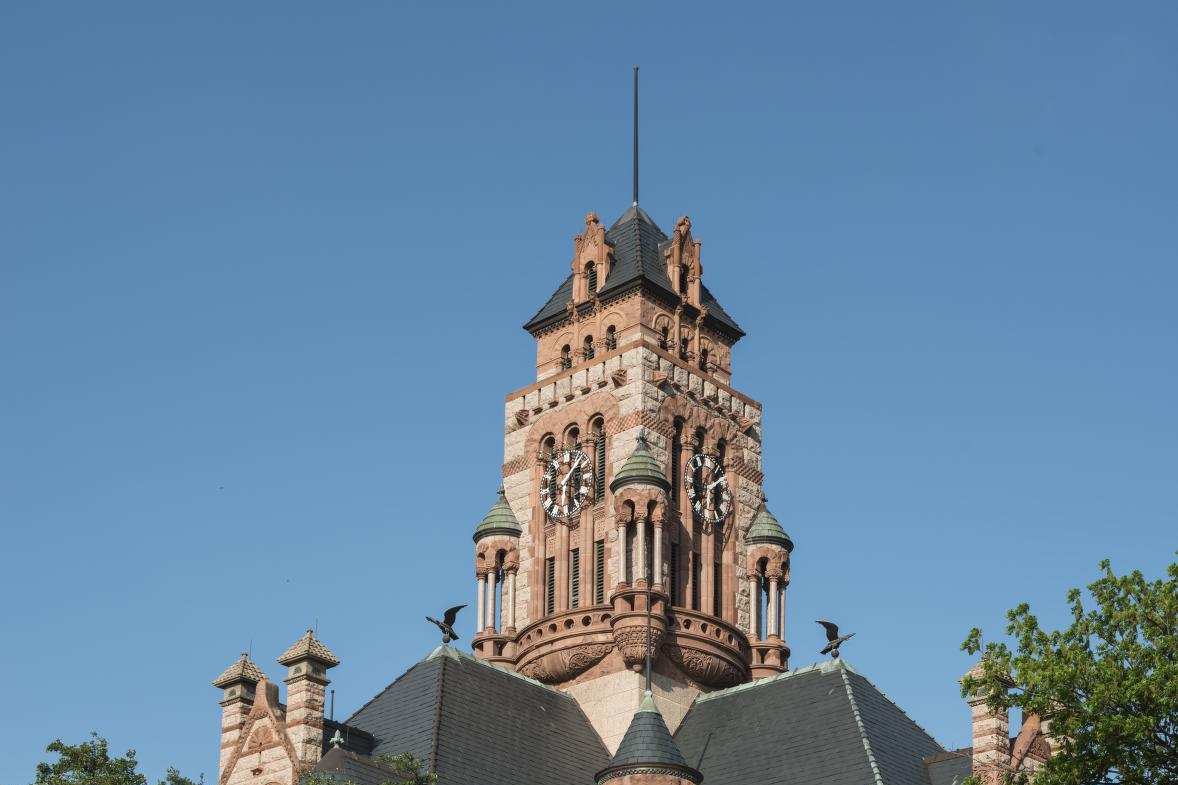
In 1984, twelve Texas courthouses designed by James Riely Gordon were still standing, and ten of them still housed the government they were built for.1 That single count, printed in his Handbook of Texas biography, is the record I want to read here. It names the counties. It gives no addresses, no condition reports, and no word on who went out and did the counting.
I keep that sentence copied onto an index card clipped inside the front cover of a folder. Most biographical entries tell you what a man did. This one also tells you what was left of it on a given date, and that makes it a baseline. Nearly everything I have learned since about Gordon’s buildings I learned by asking what became of those twelve after 1984.
A count made for a biography
The entry exists to describe a career. It follows Gordon from his birth at Winchester, Virginia, in 1863, to San Antonio, where his parents moved in 1874, through a Texas practice that ran less than twenty years, and finally to a New York office opened at the beginning of 1903.1 The number of surviving courthouses sits inside that story as a measure of reputation. The same paragraph says he drew no fewer than eighteen courthouses for the state and is chiefly remembered for them.1
The citation block on the page adds one more fact that matters to me. It gives the entry an original publication date of 1995.1 A reader in 1995 was being handed a count already eleven years old, and a reader today is handed one more than forty years old. Nothing about the sentence is wrong. It is simply dated, and the date is the most useful thing in it.
So the record was made to answer one question, how much of the architect’s work survives, and I am using it to answer a different one, what Texas later chose to do about those buildings. That is a fair use of a document as long as I keep the two questions apart. A tally meant to honor a designer was never meant as an inspection of roofs.
Why the counties could pay for him
Twelve survivors from at least eighteen raises an earlier question: how did one architect collect so many county commissions in so few years? The best short answer I have found sits in a National Register nomination written for a different county. The Shelby County courthouse square nomination records that in 1881 the legislature passed an act allowing counties to sell bonds to finance courthouses, and it credits that act with letting small, young communities build well beyond what their treasuries could have paid for outright.2 The Handbook’s survey of the building type describes the same decades from the other end: near the close of the century, a good many prospering counties replaced their earlier courthouses with large, picturesque ones.3
Credit on one side, ambition on the other. I have spent more than 35 years around decisions to borrow against revenue a borrower does not yet have, and I read the 1881 act with some sympathy for the commissioners and some for the taxpayers who carried the bonds. A stone courthouse with a clock tower is a very long lived asset, bought by a county that might or might not grow into it.
So I will say plainly where I come down, knowing good historians who would argue it with me. The bond act did more to shape the Texas courthouse of the 1880s and 1890s than any single designer did, Gordon included. He was the architect many counties hired to make their wager visible from well down the road, and he was very good at it, but the wager came first. The body that made it was the commissioners court, whose peculiar mix of powers is the subject of an essay on county government after 1876, and which the Handbook names as the body that conducts county business.3
A manner that kept changing
Gordon did not keep one style for long. His biography describes a move from a charming, eclectic Moorish manner into a strong Romanesque that owed a debt to Richardson of Boston, and then, near the end of his Texas decade, toward Classical and Beaux Arts design.1 The fuller account of those phases is in the Gordon entry on this site, and the broad run of courthouse fashions statewide is traced in the survey entry on Texas county courthouses.
The Ellis County building at Waxahachie, in the photograph above, is the one I know best. The town’s Handbook entry calls it a red sandstone and granite Victorian courthouse, completed in 1897, standing on the square.4 The Texas Historical Commission describes it as Romanesque Revival, singles out its surface ornament, its contrasting masonry and its picturesque massing, and counts it among Gordon’s best known works.5
Now watch the dates. The Handbook’s long essay on Texas architecture gives the same building as 1894 to 1896 and labels it Renaissance Revival.6 The Commission’s own project page says completed in 1897, while its table of restored courthouses, a few clicks away, lists 1895.57 Two institutions, three dates, two style names. My working guess is that the range records construction, 1897 records occupancy or dedication, and 1895 records whatever date a clerk entered when the table was built. That is a guess, and I label it that way in my notes.
What became of the twelve
Setting the 1984 sentence beside the Commission’s list of restored courthouses is where the record starts to earn its keep. Eight of the twelve counties appear on that list with a rededication date: Erath in August 2002, Hopkins in December 2002, Ellis in October 2003, Lee in October 2004, Fayette in June 2005, Harrison in June 2009, Comal in January 2013 and Bexar in July 2015. Wise is listed as in progress. Gonzales, McLennan and Victoria are not on the list.7
Fayette shows what a restoration can recover. At La Grange the Commission describes an interior court, originally open to the sky and planted, with a fountain at its heart, that the county later roofed over and filled with vaults and desks. Restoration crews reopened it between June 2003 and March 2005.8 How a state grant program came to pay for that kind of work is the subject of the next essay, on what the preservation program changed.
Where this reading breaks
The first time I put the two documents side by side, I read the three missing counties as three losses. That was wrong, or at least unproven. The restored list records finished grant projects and nothing else. By the program’s own tally, 107 historic courthouses have received some form of help, well beyond the number with a rededication date, including counties that received only planning or emergency grants.9 A county absent from the table may have restored its building with its own money, may be partway through the process, or may simply never have applied. The table cannot tell those apart, and neither can I from here.
The 1984 sentence has the same blind spot at the other end. It reports that ten of the twelve were still in use for their original purpose. It does not say which two did not.1
What to look for next time
There is a personal reason Waxahachie stays on my desk. The society I help lead as co chair, whose work is sketched on my civic page, lists its first plaque dedication at the Ellis County courthouse on February 23, 2024.10 Since then I have carried the 1984 count into every courthouse I enter.
When you next walk up to a courthouse that may be his, look past the tower. Check the rededication year on the state’s list, and notice whether the stone changes color at each floor line. Then ask the question the Handbook asked in 1984, which is also the one every essay in the courthouses series keeps returning to: does the building still house the county’s business, or has it become a monument to it?
References
-
Handbook of Texas Online, Texas State Historical Association, Gordon, James Riely ↩ ↩2 ↩3 ↩4 ↩5 ↩6
-
National Register of Historic Places nomination, Shelby County Courthouse Square, Center, Texas, via Texas Historical Commission Atlas, Shelby County Courthouse Square ↩
-
Handbook of Texas Online, Texas State Historical Association, County Courthouses ↩ ↩2
-
Handbook of Texas Online, Texas State Historical Association, Waxahachie, TX ↩
-
Texas Historical Commission, Ellis County Courthouse ↩ ↩2
-
Handbook of Texas Online, Texas State Historical Association, Architecture ↩
-
Texas Historical Commission, Restored Historic Courthouses ↩ ↩2
-
Texas Historical Commission, Fayette County Courthouse ↩
-
Texas Historical Commission, Texas Historic Courthouse Preservation Program ↩
-
Alamo Letter Society, Dedication Dates ↩