A friend who sits on a county historical commission asked me over lunch what the state courthouse program had really changed. Counties had always repaired their buildings, she said, or failed to. What was different now?
I did not have a good answer at the table, which bothered me enough to go and build one. It turned into a research problem of the ordinary kind, where the facts are public and the difficulty is getting them to agree.
The starting point is the reason the program exists. By the Texas Historical Commission’s account, lawmakers set up the courthouse grant program in 1999 to halt a long decline, after four decades, beginning in the 1950s, during which a good many old courthouses burned or were knocked down.1 The Handbook of Texas describes an older and narrower protection, a law passed after legislators and citizens grew alarmed at old courthouses being pulled down to make room for new ones, and it says that law protects the buildings only to a limited extent.2 So the before picture is a building type with some legal cover and very little money. The agency itself started life in 1953 under a longer name, the Texas State Historical Survey Committee, and was renamed in 1973; its history has a reference entry of its own.3
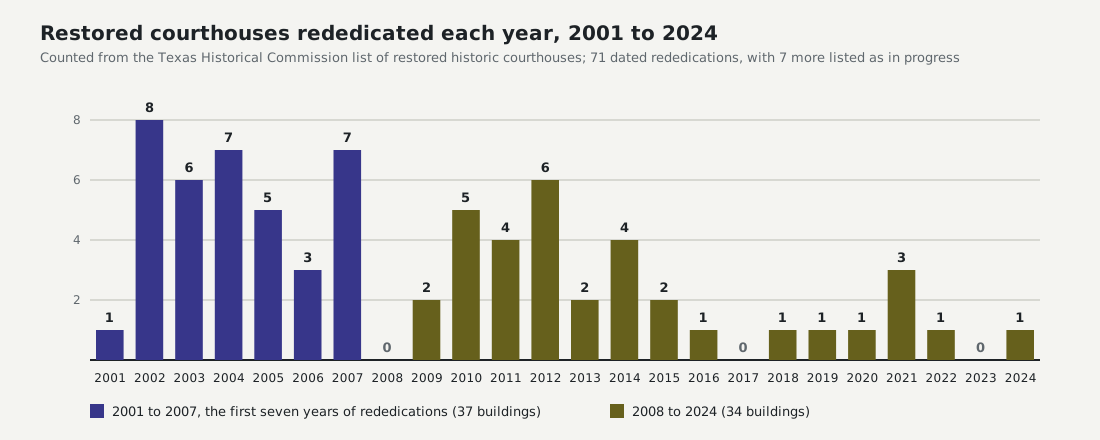
Next I wanted to see the after picture as a pattern rather than a list. On its website the agency publishes a list of finished restorations, one row per county, giving the town, the day of rededication and the year the building was originally finished. I counted it by hand and then again with a short script. It holds 78 counties: 71 with a rededication date, running from Shackelford County at Albany in June 2001 to Mason County in July 2024, and 7 marked in progress.4 The chart above is that count by year. Thirty seven rededications fall in the first seven years, and thirty four in the seventeen years after.
The grant rounds show up in individual project pages rather than in the table. Dallas County is a clean example. Its planning money came in round two, in 2001; its building money came in round four, three years later, and paid for a new copy of the lost clock tower on the courthouse discussed in the essay on Old Red.5 A planning grant three years ahead of the construction money is the pattern I would expect from any serious capital program, and it explains why the early rededications bunch together: the counties that were ready first went first.
Where the sources refuse to agree
Then the numbers stopped lining up. The program’s own main page says it has helped 107 historic county courthouses, with grants totaling above $500 million, including 89 counties with full restoration construction projects and 31 with emergency or planning projects.1 The 89 and the 31 add to 120, which is more than 107, so some counties must be counted in both groups. And 89 full restoration projects is more than the 78 rows in the restored table. Both pages come from the same agency, and I have no reason to think either is wrong. They count different things, and neither says precisely what.
The single building I know best gave me the same trouble in miniature. The commission’s page for the Ellis County courthouse at Waxahachie says it was rededicated in October 2002. The restored table gives October 4, 2003.46 One of those is a typing slip or a second ceremony, and nothing on either page tells me which. The Gordon courthouses have a longer history of disagreeing dates, set out in the essay on James Riely Gordon and the building boom.
My judgment call was to trust the table for patterns and the project pages for particulars, and to cite whichever one I actually used. When they conflict on a date I give both. It is an unglamorous rule. It keeps me from quietly choosing the number that makes a sentence tidier.
Here is the answer I finally gave my friend, and I expect some preservation people to disagree with it. The largest change was the paper. Before 1999 each county decided alone, in its own commissioners court, whether to fix, replace or abandon its courthouse, a body whose powers are traced in the essay on county government after 1876. Those decisions left their minutes scattered across county offices all over the state. Afterward, a county that wanted state money had to enter a biannual, competitive application process run from Austin, and the results landed in one public table.1 The money mattered enormously. The common record may outlast it.
Where that argument weakens is exactly where the numbers disagree. A single record is only as good as the definitions behind it, and the program’s two counts show that even the agency keeping the record has not settled what counts as assisted. A researcher fifty years from now who trusts the table alone will undercount the counties the program touched. The table also says nothing about the counties missing from it, which is most of Texas’s 254, and whose buildings might be in excellent shape or quietly failing.1
The commission has added a quieter layer since. Beginning in 2006 it has run regional workshops that train county facility managers in maintenance, with funding it credits to the Texas Land Title Association.1 Nothing in a rededication table measures that.
I think about this program more than I expected to, partly because the bronze plaques that come up on the page about my civic commitments keep taking me into restored buildings, and partly because nearly every piece in this run of courthouse essays leans on those project pages. What stays with me is the row itself. Each line in the table stands for somebody in a county office who read the rules, assembled the drawings and the photographs, filled out the application, and then waited for a round to close.
References
-
Texas Historical Commission, Texas Historic Courthouse Preservation Program ↩ ↩2 ↩3 ↩4 ↩5
-
Handbook of Texas Online, Texas State Historical Association, County Courthouses ↩
-
Handbook of Texas Online, Texas State Historical Association, Texas Historical Commission ↩
-
Texas Historical Commission, Restored Historic Courthouses ↩ ↩2
-
Texas Historical Commission, Dallas County Courthouse ↩
-
Texas Historical Commission, Ellis County Courthouse ↩