“Five hundred eighty four thousand dollars.” I said the sum under my breath twice before it registered, because on first reading it seemed to belong to some other building. It sits near the bottom of the description page of the National Register nomination for the Dallas County Courthouse, prepared in September 1976, and it is the total cost of a renovation begun in November 1968: better lighting and plumbing, two new staircases, a new elevator, all at $13.50 a square foot.1
What stopped me was the date. By 1968 the county had already put up a newer building. The same form says so plainly, and then adds that the old Romanesque courthouse continued to serve the functions of county government anyway.1 Dallas had replaced the building and then spent more than half a million dollars modernizing it. The facts of the building are laid out in the reference entry on Old Red. This essay is about that one line item, and about what it tells me the county decided to keep.
What the form was made for
A National Register nomination is an argument for significance, written to a federal standard. This one was prepared at the Texas Tech division of architecture by Willard B. Robinson and S. Elizabeth Sasser, received by the National Park Service in October 1976 and entered on the Register that December.1 Its job was to show why the building mattered as architecture, and most of it does exactly that.
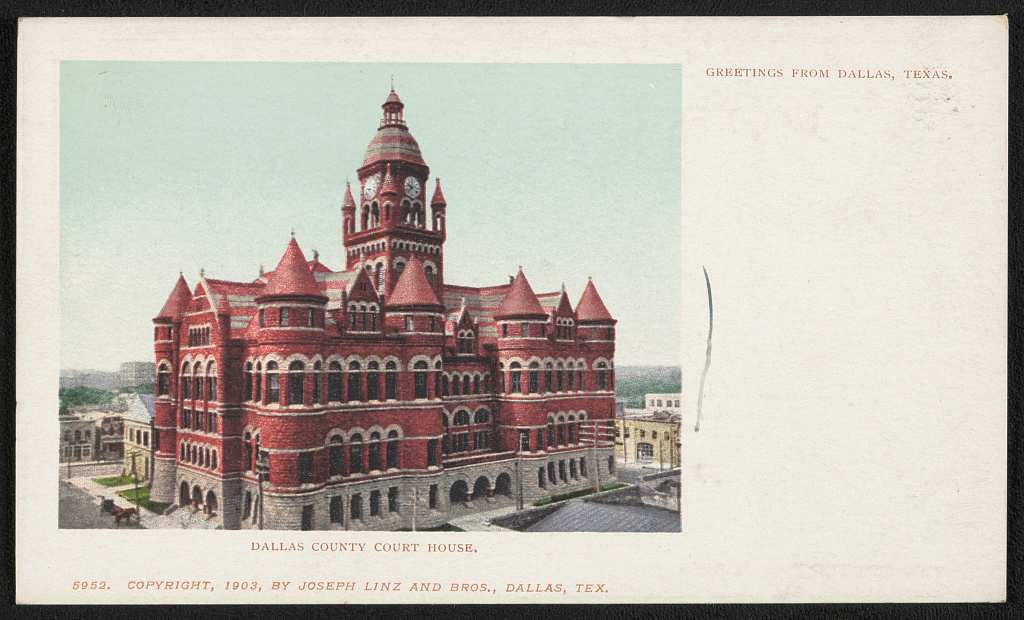
It describes a base of blue granite from Arkansas, upper walls of red Pecos sandstone trimmed in lighter stone, entrance columns of marble from Burnet, and eight round turrets.1 It records that the central tower, 205 feet tall and at the time of construction the second tallest structure in the state, came down after a structural failure in February 1919.1 It notes that of the terra cotta griffins that once stood on every elevation, only two remained, one in place and one held in the archives of the Dallas Historical Commission.1 The postcard above, copyrighted in 1903, shows the tower still in place.2
The form also preserves how hard the building was to get. The contract went to R. L. James in July 1890 on an estimate of $276,967.50, and the cornerstone was laid that November. A strike over wages followed, and on July 20, 1891, the commissioners court relieved James of the job and kept the architect, M. A. Orlopp, on as superintendent. The county moved in during the winter of 1892, over budget.1
I mention that history with some caution, because in my working life I have learned to distrust any argument that rests on money already spent. A cost that cannot be recovered should not decide what happens next. Yet I suspect it weighed on the commissioners who approved the 1968 work, and I am not sure they were wrong to let it. A building a county fought that hard to finish carries a kind of civic memory that no balance sheet records.
Nothing in the form’s purpose required it to record a plumbing bill. The authors included the 1968 renovation as a fact about alterations, the sort of thing a reviewer needs in order to judge how much of the original survives.1 They were not making a case about why Dallas kept the building. The evidence for that case is there anyway, sitting in the list of changes.
The use that saved it
Here is the argument I would make at any table in this city, knowing that people who have spent careers in preservation would push back hard. The 1968 renovation did more to keep Old Red standing than the 1976 listing did.
Listing on the Register is a recognition. It does not by itself stop a county from tearing a building down, and courthouses were being lost across Texas in exactly those decades; the Texas Historical Commission dates a wave of losses, by fire and by the wrecking ball, from the 1950s onward.3 A building that goes empty begins losing arguments the day the lights go off. A building with employees in it, working elevators and a fresh appropriation behind it, has a constituency that shows up at budget time.
The owner was the county, not the city, and the decisions ran through the commissioners court, a body whose odd name and wide powers are explained in a Reconstruction essay on county government after 1876.1 That court had every ordinary reason to let the old building go once the new one opened. Instead it treated the old courthouse as office space worth paying for. I read that as a practical judgment rather than a sentimental one, and I trust practical judgments to last longer.
The site itself argued for staying put. The nomination says the block had been the center of county government since the founding of Dallas, and it walks through the courthouses that stood there before this one: a small log building on a corner of the square, a brick courthouse authorized in 1855, and a granite one begun in 1871.1 How the square ordered everything around it is the subject of the essay on the square as a town plan. A county that had governed from one block for that long had built its daily routines around it, and emptying the old building would have cost something too.
What the keeping cost
Where my argument breaks is inside the building. The same use that kept Old Red alive also changed it. New staircases and an elevator are exactly the alterations a later restoration has to reckon with, and the nomination already flags the building as altered in 1976.1 When the county came back to the building a generation later, with state grant money, the Texas Historical Commission’s account of that work describes a staircase of cast iron rebuilt with surviving pieces of the first one, courtroom walls and ceilings repainted in the colors they first wore, and a copy of the vanished tower put back on the roof.4 Part of what the restoration paid for was undoing what continued use had done.
I do not think that makes the 1968 decision wrong. It makes it a trade, and the honest way to describe a trade is to name both sides. Dallas County got years more of working offices. The building paid in original fabric, some of which could be rebuilt from surviving pieces and some of which could not.
The later history turned the trade into a new use. State money arrived in two stages, for planning in 2001 and for building in 2004, and the county history museum inside grew with the work; the rededication came on May 15, 2007.4 Why the state began paying for such work at all is the question behind the companion essay on the preservation program. Photographs and papers of the sort such a museum draws on are also the business of the institution described in the entry on the Dallas Historical Society, where I serve as a trustee, and the rest of my civic work is listed on the civic page.
There is one thing the 1976 form could not know. Its present use box is checked for government, not museum.1 The people who filled it out were describing a working courthouse annex, and they had no way to see that the building’s second life would be as an exhibit about the first. Of all the buildings in the courthouse essays, Old Red is the one whose survival I understand least romantically and respect most.
Dallas kept the stone, the square and the name, and it gave up the courts.
References
-
National Register of Historic Places nomination, Dallas County Courthouse, 1976, via Texas Historical Commission Atlas, Dallas County Courthouse ↩ ↩2 ↩3 ↩4 ↩5 ↩6 ↩7 ↩8 ↩9 ↩10 ↩11 ↩12
-
Library of Congress, Prints and Photographs Division, Greetings from Dallas, Texas, Dallas County Court House ↩
-
Texas Historical Commission, Texas Historic Courthouse Preservation Program ↩
-
Texas Historical Commission, Dallas County Courthouse ↩ ↩2