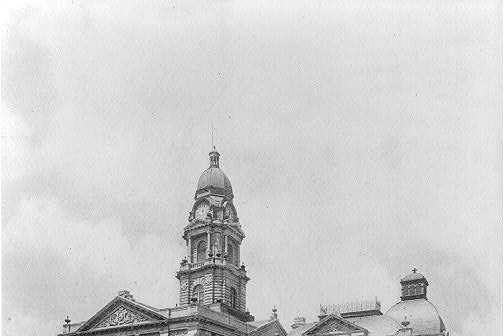
The phone call usually opens with a date. Someone on a county committee has an old photograph of the courthouse, the tower shows a round white face with hands on it, and the caller wants to know whether that settles the year the county clock started running.
It never settles it, and the reason is the research problem worth writing down. A clock face is a piece of architecture. A clock is a machine that somebody bought, installed, wound and paid to repair. The two can sit in the same tower for decades or be separated by decades, and a photograph can only ever show the first.
A face with nothing behind it
The case I cite to every caller is Newton County. Its courthouse went up in 1902 in the Second Empire style, three stories of brick with a clock and bell tower and a mansard roof. According to the Texas Historical Commission, the tower originally carried a faux clock. A working four faced clock arrived only in 1929, put there by local benefactors in honor of Dr. J. S. Peavy and Maryann Fuller.1 For twenty seven years, then, any photograph of that square showed a timepiece that did not keep time.
I do not read that as a deception, and here is a view some preservation people would dispute. A dummy face was an honest statement of a county’s means and its intentions at once. A county that built the tower and put a face in it was telling the square what it meant to have. The cost of a real clock came due in a later generation, and it came from private hands.1 I would rather read a dummy clock as a promise than dismiss it as show, though I grant that a visitor in 1910 checking his watch against it would have been badly served.
Dating the photograph first
So the first step is to date the picture independently of the clock. The picture above is catalogued by the Library of Congress as the Tarrant County courthouse in Fort Worth, about 1901, a photogravure copyrighted by C. L. Swartz of the Albertype Company. The catalogue itself warns that the record carries unverified data from an old caption card.2 The Handbook of Texas dates that courthouse to 1893 through 1895 and credits it to Gunn and Curtis, and files it with the Renaissance Revival buildings that prosperous counties favored at the end of the century.3
Those two sources bracket the image: not before the building was finished, and probably not long after the copyright. What they cannot tell me is whether the face on the tower had works behind it on the day the plate was made. For that I would need the commissioners’ orders for the clock, a bill of sale or a newspaper notice of its first striking, and I have not found them for Fort Worth. The body that would have voted the money is the one described in my essay on county government after 1876, and its minutes are where a contract of this kind would be entered.
The building has a paper trail of its own on a different question. In December 1893 a Fort Worth man charged that the granite going into the new courthouse was of an inferior class to the stone contracted for, and the county commissioners heard him behind closed doors.4 That quarrel belongs to the essay on where courthouse stone came from, but it is a reminder that a courthouse was bought piece by piece, and the clock was one line among many.
What the tower record shows
Once the photograph is placed, the restoration files do the rest, because they record when a clock was lost as carefully as when it was built. Bosque County’s 1886 limestone courthouse had an off center clock tower in the Italianate manner. A 1934 WPA project removed the tower and the whole roof, and put a single clock face into a new cast stone parapet. The tower was reconstructed in the restoration of 2005 to 2007, trucked to Meridian and craned into place with hundreds watching.5 A hurricane in 1909 took the tall clock tower off the Colorado County courthouse, and a dome went up in its place.6
Sometimes the record shows a county declining to buy the mechanism at all. The 1931 La Salle County courthouse at Cotulla was built after a $150,000 bond election, and the clocks were among several features cut from the project.7 Elsewhere the clock was the thing a county fought to keep. After a tornado badly damaged the Hood County tower in 1968, the commissioners at first proposed to remove it; the local paper printed coupons for readers to send in, the court was flooded with them, and schoolchildren gave coins toward the repairs.8 At Cooke County the state program paid in its fifth round to put the original tower clock back in working order.9
The architect whose name comes up most often with these buildings, whose career is summarized in the entry on J. Riely Gordon, designed no fewer than eighteen Texas courthouses.10 His 1899 Lee County building at Giddings has a clock tower with a face on each side.11 The eras and styles those towers belong to are set out in the overview of Texas county courthouses.
Where the method stops
The method works on towers that were built, cut, blown off or rebuilt, because each of those events generated paper. It fails on the quiet years in between. A clock can stop and stay stopped for a decade without a single vote being taken, and a photograph from that decade will show hands frozen at some hour nobody wrote down. A date built on one such photograph can be wrong in a way that no later source will ever expose, and nothing I know of will catch the error.
There is also the matter of what a clock was for. Public time on the square served the same audience as the printed notices posted below it, people who came to town on business and needed the county’s version of things. That is close to the argument of the essay on how the Travis letter reached readers as type: what the public met first was a copy made for the public. My own time in these lobbies comes through the plaque work described on the civic page, and the other essays on these buildings are gathered under courthouses.
When the next caller asks, I will say what I always say. Date the picture, then find the bill.
Newton County built its 1902 courthouse and jail together for $21,947, and waited until 1929 for a clock that kept the hour.1
References
-
Texas Historical Commission, Newton County Courthouse. ↩ ↩2 ↩3
-
Library of Congress, Prints and Photographs Division, Tarrant county courthouse, Fort Worth, Texas. ↩
-
Handbook of Texas Online, Texas State Historical Association, County Courthouses. ↩
-
San Antonio Daily Light (San Antonio, Tex.), December 18, 1893, page one, Chronicling America, Library of Congress, San Antonio daily light, December 18, 1893. ↩
-
Texas Historical Commission, Bosque County Courthouse. ↩
-
Texas Historical Commission, Colorado County Courthouse. ↩
-
Texas Historical Commission, La Salle County Courthouse. ↩
-
Texas Historical Commission, Hood County Courthouse. ↩
-
Texas Historical Commission, Cooke County Courthouse. ↩
-
Handbook of Texas Online, Texas State Historical Association, Gordon, James Riely. ↩
-
Texas Historical Commission, Lee County Courthouse. ↩