I unrolled a road map of Texas across the dining table one evening and drew a pencil line from San Antonio east to Gonzales, then on to the old site of San Felipe on the Brazos. It is a short line on a modern map. In February 1836 it was the road taken by a document every Texas schoolchild now meets, and the thing that interested me was where the line stopped. It stopped at a printing office.
The State Library’s image of the letter’s first page carries a note, inverted on the page, telling whoever held it to rush the sheet to San Felipe without stopping.1 San Felipe was not the nearest town to the Alamo. What it had, since October 10, 1835, was a newspaper, the Telegraph, begun there by Gail Borden Jr., Thomas H. Borden and Joseph Baker, which the Handbook of Texas credits as the first paper in Texas to last.2
The record I want to read is the account the Texas State Library gives of the letter’s first weeks in the world, because it is really an account of type.3 Its wording and its long road to the state archives belong to the letter’s reference entry. This essay stays with March 1836.
From courier to composing stick
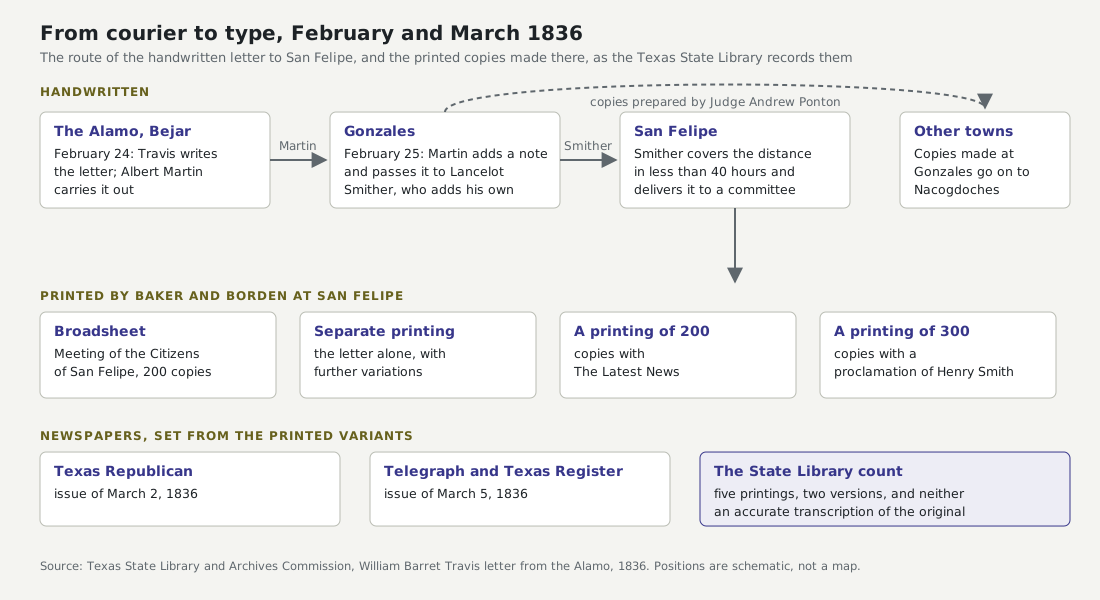
The handwritten stage was fast and brief. Capt. Albert Martin carried the letter out on February 24 and, at Gonzales, handed it to Lancelot Smither, who added his own note on the back.45 By the State Library’s reckoning Smither rode it in under two days, into a cold north wind, and delivered it to the citizens’ committee there.3
From that point the letter became a job of work in a small shop. The library’s account lists what Baker and the Bordens produced: a broadsheet carrying the proceedings of the San Felipe citizens alongside the letter, 200 copies of it run off on the committee’s order; a separate printing of the letter showing still more departures from the handwritten original; another run of 200 with The Latest News added; and a run of 300 carrying a proclamation of Provisional Governor Henry Smith.3 It counts five distinct printings from the shop, in two versions, and says that neither version transcribed the appeal accurately.3
The newspapers followed the broadsheets rather than the letter. Two papers carried it, the Texas Republican first, on March 2, and the Telegraph three days later, and both set their text from the shop’s variants rather than from the manuscript.3 So did a dozen or more reprintings in Texas histories published between 1836 and 1891, which the library reads as a sign that the original went back to the Travis family soon after the Revolution.3 For more than half a century, readers who thought they were reading Travis were reading his printers.
The size of that audience is worth keeping in view. The Telegraph claimed a circulation of 500 by December 14, 1835, and when Gail Borden resumed it at Columbia that summer, its first number there, on August 2, 1836, printed the new constitution of the Republic, which the Handbook says very few people had seen until then. By the end of October the paper had 700 subscribers.2 In the Texas of 1836 a document became public when a press made it so, and a run of a few hundred copies was how a text reached the public.
It is worth remembering who those printers were. Baker had come to San Felipe in 1831, taught school there for three years, and served as secretary of the ayuntamiento, the town council, in 1835.6 Thomas Borden had come to Texas in 1824 as one of Austin’s Old Three Hundred and had served for a time as the colony’s official surveyor.7 They were local men with a press, setting type by hand against a deadline. The Handbook records that the publishers retired after issuing the paper on March 24, and that when the press was moved to Harrisburg, Mexican troops captured the printers and threw the press into Buffalo Bayou.2 Every broadsheet copy of the letter that circulated that spring came off that one shop’s press, and the press did not survive the war.
What written for printers means
The title of this essay makes a claim I cannot prove, and I want to be plain about that. I think Travis wrote this dispatch expecting it to be set in type. The heading reaches past any one official to the people of Texas and to Americans everywhere, and the inverted note routes it to a town with a working newspaper.12 A man writing to a single official does not address the world. A man who wants his words multiplied sends them where the multiplying is done.
A careful historian could answer that the address was a figure of speech common to the period, and that San Felipe mattered for reasons unconnected to type. That is a fair reading, and the documents do not settle it. The State Library also notes a parallel handwritten route: Smither appears to have left a condensed copy with Judge Andrew Ponton at Gonzales, and Ponton prepared further copies and sent them toward Nacogdoches and other settlements.38 Handwriting still moved news in 1836, and the Ponton copies are a reminder that type was one channel among several.
Here is where my own reading has gone wrong. For years I quoted the letter from whatever printed version was nearest to hand, on the assumption that a text reprinted that often must be settled. The library’s account ended that habit. If both 1836 versions were inaccurate, then every later copy made from them carries the printers’ changes forward, and a quotation is only as good as the page it came from. I now go to the State Library’s images of the four handwritten pages, and I would advise anyone quoting the letter to do the same.1
That matters to me personally, because the Alamo Letter Society, which I helped found and serve as co chair, places a bronze of the full text in county courthouses.9 The society works through each county’s judge, who chairs the commissioners court described in the essay on county government after 1876, and the society itself is the subject of its own reference entry.910 My part in it is summarized on the civic page. Those plaques put the letter on courthouse squares of the kind examined in the town plan essay, sometimes in buildings crowned by the kind of tower the series considers in a piece on courthouse clocks and county pride. A visitor there meets Travis much as a Texan did in March 1836, through a copy made by other hands. Other buildings and records appear across the courthouse hub.
I have come to think of the San Felipe printings as the first public edition of the letter, with all that the word edition implies: decisions about the text made by people other than the author, under pressure, for readers who would never see the original. That edition shaped how Texas knew the document for two generations. It is also a fine record of how news traveled in a revolution, which is its own kind of evidence.
The rule I take from the map on the table is simple. A printed copy tells you what readers had in their hands, and on that it can be trusted. It cannot tell you what the writer put on his page.
References
-
Texas State Library and Archives Commission, William Barret Travis’ Letter from the Alamo, 1836, Page 1 ↩ ↩2 ↩3
-
Handbook of Texas Online, Texas State Historical Association, Telegraph and Texas Register ↩ ↩2 ↩3 ↩4
-
Texas State Library and Archives Commission, William Barret Travis’ Letter from the Alamo, 1836, About the Letter ↩ ↩2 ↩3 ↩4 ↩5 ↩6 ↩7
-
Handbook of Texas Online, Texas State Historical Association, Martin, Albert ↩
-
Handbook of Texas Online, Texas State Historical Association, Smither, Launcelot ↩
-
Handbook of Texas Online, Texas State Historical Association, Baker, Joseph ↩
-
Handbook of Texas Online, Texas State Historical Association, Borden, Thomas Henry ↩
-
Handbook of Texas Online, Texas State Historical Association, Ponton, Andrew ↩
-
Alamo Letter Society, Alamo Letter Society ↩ ↩2
-
Handbook of Texas Online, Texas State Historical Association, County Courthouses ↩