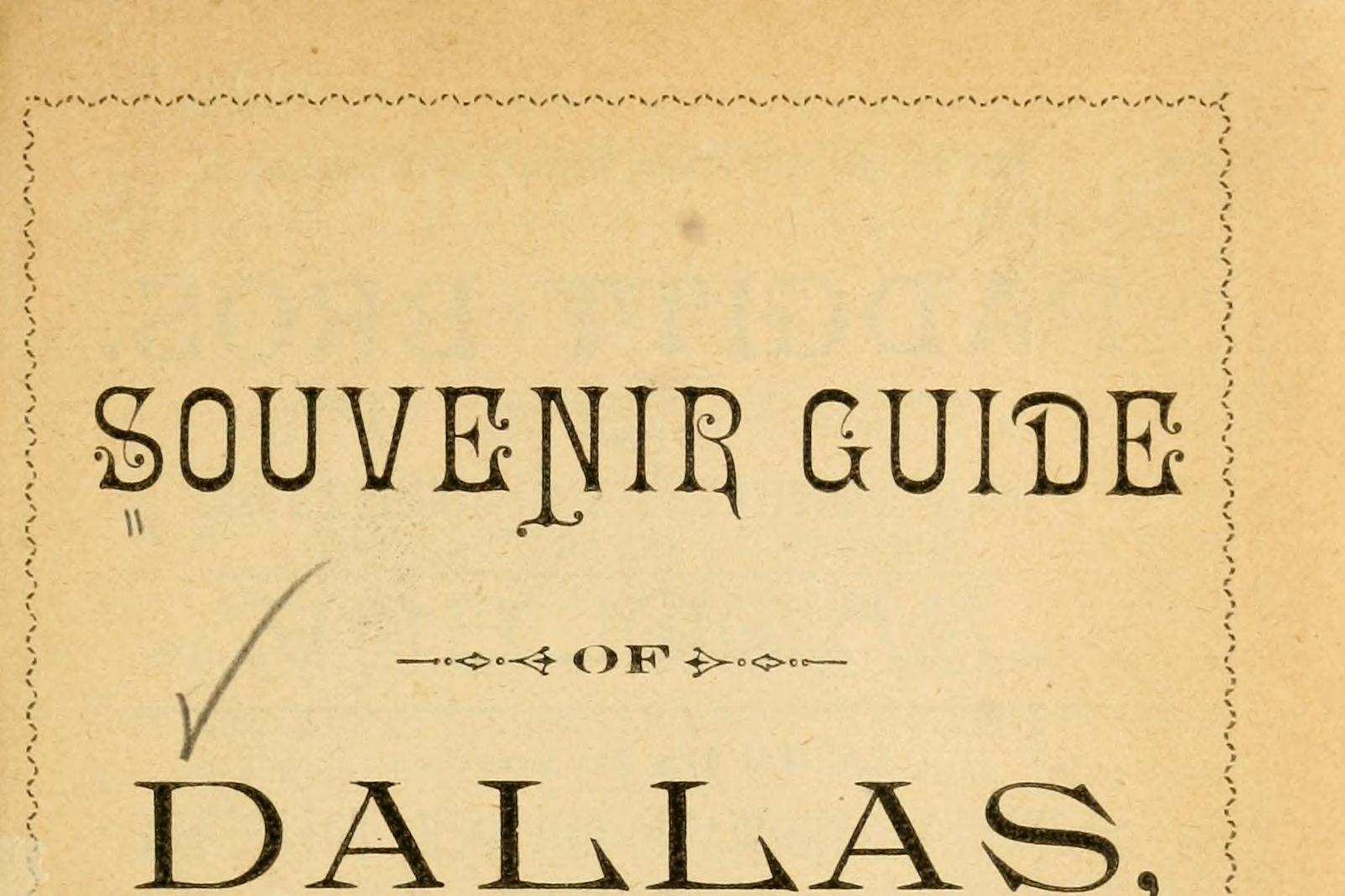
On page five of a pocket guide printed in Dallas in 1894, the compiler tells his readers that a young man pitched a lonely tent on the banks of the Trinity in 1840 and had no idea he was founding what the guide calls “the future metropolis of the South.”1 The young man is John Neely Bryan. The sentence is confident, and the year is wrong.
Finding out how wrong, and why, is a small research problem of the kind I like best, because the answer does not depend on cleverness. It depends on knowing what each record was made to do.
A guide printed for advertisers
The book is the Souvenir Guide of Dallas, compiled and published by the D. M. Anderson Directory Company and printed at J. M. Colville’s Franklin Print.1 Its title page promises a sketch of the city and county and a directory of the leading business firms. Turn a few leaves and the purpose is plain. The historical sketch runs in short stretches between full pages of advertising: a saddlery house, a fancy grocer, a dry goods store, a national bank with its paid up capital printed in large type.1
That is a document written to sell a place. Nothing in it is dishonest in the ordinary sense, but everything in it leans the same way. The same page that dates Bryan’s tent says the city had only 1,700 people in 1870 and now counts 61,855 souls.1 The Handbook of Texas gives about 3,000 for 1870 and 38,067 for 1890, after the annexation of East Dallas.2 A booster needs a small beginning and a large present, and both of the guide’s numbers bend toward that shape.
So I read the 1840 date as part of a pattern and not as a slip of the pen.
Three years for one arrival
The account I trust most is the Handbook’s biography of Bryan. It says he made his first trip to the site in 1839, went back to Van Buren in Arkansas to settle his affairs, and returned to Texas in November 1841, when he settled on the east bank of the Trinity near the present downtown.3 The Handbook’s Dallas article agrees on November 1841 and adds that he chose a spot near a natural ford where two Indian traces met.2 So the records give me 1839 for a visit, 1841 for a settlement, and the guide’s 1840 for neither.
I cannot tell whether the guide’s compiler folded the first visit into the settlement or simply wrote down a year that sounded right. Either way the date belongs to the guide and not to Bryan, and that is how I cite it.
The Handbook is not a primary record either, and I try not to forget it. Its entry on Bryan names its sources, a 1936 life of Bryan and a 1951 history of the city, and I give it more weight because I can see what it stands on.3 Two of its own entries also part on a detail. The biography says Bryan persuaded J. P. Dumas to survey and plat the town in 1844 and possibly helped him, while the city entry speaks of Bryan’s original survey laid out with the river as its western edge.32 When one reference work credits the same plat to two hands, I write around the question of authorship and keep the year.
My own view, which I know many people who love this city would reject, is that Dallas is better dated from that 1844 plat than from any tent. A camp is a person’s decision. A plat is a claim other people can buy into, and a town is what happens when they do.
What the founding story leaves out
The firm parts of Bryan’s record are less romantic than the guide’s page and more useful. He ran a ferry where Commerce Street now meets the river, served as postmaster under the Republic, helped organize the county in 1846, and gave the land for the courthouse when Dallas became the county seat in 1850.3 That gift is the root of the courthouse square, whose later life I follow in a courthouse essay on the 1892 building. He also sat on land the Republic had granted to the Peters colony, and had to make his claim good afterward.2 In 1852 Alexander and Sarah Horton Cockrell bought his remaining interest in the townsite for $7,000.2
The later years are harder. In 1855 he shot a man, fled, and stayed away about six years even though the man recovered. He came back, served in a Confederate cavalry regiment, and took part in civic life again, but his mind was failing by 1874, and he died in the state asylum in Austin in September 1877.3 A guide printed for advertisers had no room for any of that. A founding story told only from the guide would be tidy and false.
The settlers who arrived after Bryan are part of the same correction. When the nearby French colony of La Réunion broke up in the late 1850s, its craftsmen moved into town, a story told in the essay on the settlers who stayed.2 Bryan’s own life, dated from the sources I trust, is set out in the reference entry on him.
My method broke here once before, in a different archive. I trusted a later compilation over a scattered earlier record because the compilation was cleaner, and I carried its date forward for months. Clean is not the same as close. The guide is the cleanest account of Bryan I own, and it is the one I trust least.
The next place I would go is the papers of the Cockrells, which the Dallas Historical Society holds along with those of John C. McCoy and others among the city’s early figures.4 I am a trustee of that society, as the civic page notes, and a short account of the institution sits in its reference entry. Where those papers now sit, in a building made for the centennial, is where my essay on the Hall of State picks up, and the rest of this series is gathered on the Dallas history hub.
A wrong year costs nothing to print and a great deal of work to remove.
References
-
Library of Congress, Souvenir guide of Dallas. A sketch of Dallas and Dallas county, their resources, business enterprises, manufacturing and agricultural advantages, D. M. Anderson Directory Company, 1894, title page and page five. ↩ ↩2 ↩3 ↩4
-
Texas State Historical Association, Handbook of Texas, Dallas, TX ↩ ↩2 ↩3 ↩4 ↩5 ↩6
-
Texas State Historical Association, Handbook of Texas, Bryan, John Neely ↩ ↩2 ↩3 ↩4 ↩5
-
Texas State Historical Association, Handbook of Texas, Dallas Historical Society ↩