The document on the table was a compliance certificate, one page, signed by the chief financial officer the afternoon before the meeting. It set out the quarter’s covenant tests the way lenders like them, with the required figure in one column, the actual figure in the next, and a single word in the third. Total debt could be no more than three times the last twelve months of earnings. The company stood at 2.4. The word in the third column was compliant.
Clipped to the certificate was a purchase request for $1.1 million, the price of a new pump truck, with a letter from an operator saying it would have work for the unit through the spring. The company had about that much cash above the floor it liked to keep. The chief financial officer wanted to send it to the bank as a prepayment on the term loan. The operations vice president wanted the truck. Both had brought numbers, and the board had forty minutes.
The best argument for the truck came from a director who had run a service company himself, and it deserves to be heard out in full. A service company that stops adding equipment in a good year does not stay still; it shrinks relative to its customers, who are adding wells. The operator’s letter is a relationship offered, and a company that declines it teaches the operator to call someone else first. Debt, meanwhile, is the cheapest money the company has, and paying it down early is a gift to a bank that did not ask for one. The ratio sits well inside the test. If things turn, covenants can be reset; lenders grant waivers every quarter to companies they want to keep. And the prepayment is permanent. Cash sent to retire a term loan does not come back, while a truck can always be sold. On that view the board should buy the truck, keep the customer, and worry about the ratio when the ratio gives it reason.
Most of that holds up. The point about permanence, in particular, is correct and too often missed.
Working it through
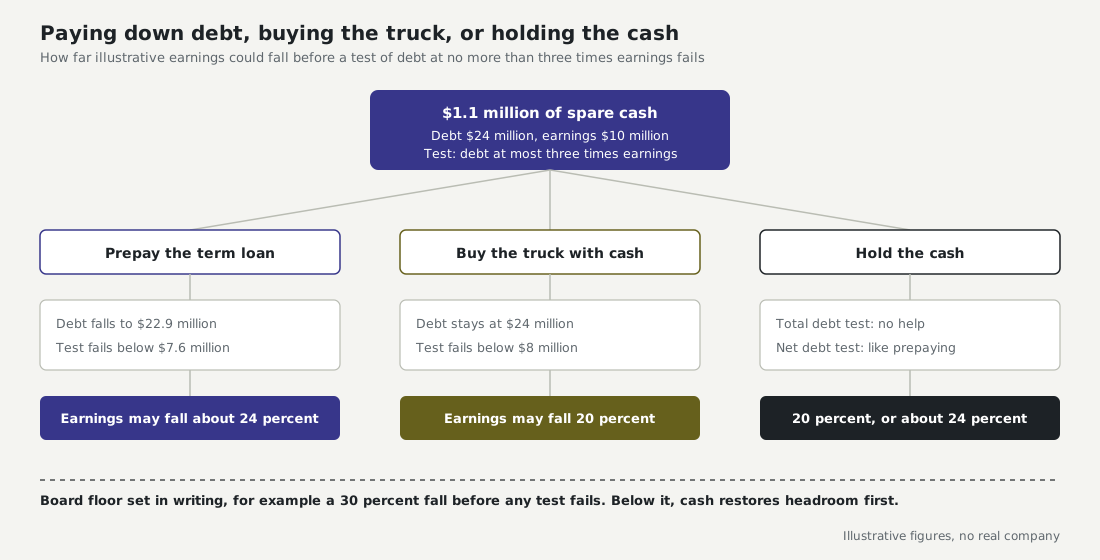
Put illustrative numbers on the certificate. Trailing earnings of $10 million and total debt of $24 million give the 2.4 on the page. The test fails when debt exceeds three times earnings, so with $24 million outstanding it fails once earnings fall below $8 million, a decline of 20 percent. That figure, how far earnings can fall before the lender acquires a vote on the company’s affairs, is what I mean by headroom. It is the number I want a board to discuss, and it appears nowhere on the certificate.
Now the three choices. Prepay $1.1 million and debt drops to $22.9 million; the test then fails below about $7.6 million, so earnings could fall roughly 24 percent. Buy the truck with cash and debt stays at $24 million, with headroom of 20 percent before the new unit earns anything. The third option, the one nobody at that table had proposed, is to hold the cash. Whether that helps depends on a phrase in the credit agreement. If the test uses total debt, cash in the bank adds liquidity but not one point of headroom. If it uses debt net of cash, holding the money does nearly what the prepayment does and keeps the option the director rightly prized. Most boards I have sat with could not say which definition their own agreement used.
How large a fall should a company plan for? Nobody can say, and I will not guess at the next cycle. But the recent past gives a sense of scale. In a study commissioned by the Energy Information Administration, average drilling and completion costs per well in five onshore areas were 25 to 30 percent lower in 2015 than in 2012.1 Equipment and pumping horsepower for fracturing alone made up about a quarter of what an onshore well cost to drill and complete.1 Much of what operators stopped spending in those years had been service company revenue. A fall of 20 percent in a service company’s earnings is an ordinary bad year, not a catastrophe.
So my position, which the director with the operator’s letter would oppose, is this. Before it hears any purchase request, a board should set a minimum headroom in writing, say a 30 percent fall in earnings before any test fails, and treat every use of spare cash as a question of whether the company is above that line or below it. Below the line, the cash goes to restoring headroom, by prepayment or by holding it where the definition allows, and the truck waits however good the letter is. Above the line, management spends as it judges best. The board decides the number. Management decides the trucks.
The principle is simple, and it has failed me. On one board I held the company to a headroom floor and the unit it wanted went unbought. A competitor bought one that summer and took the work the letter had promised, and the downturn I was guarding against did not arrive for two more years. By then that operator had a new first call. The rule protected the company from a covenant crisis that never came, and it cost a customer that did not come back. I still think the floor was right, but I set it that year with more certainty than the facts supported, and I no longer pretend the choice is free.
Two structural points sit under all of this. The covenant package, and who on the board gets a real vote on questions like this one, is usually settled long before the first certificate, in the governance terms agreed at the letter of intent. And in a company whose founder has recently moved to the chair, the headroom number is a good first piece of work for him, a board question that keeps him out of the yard, as I argue in the piece on a founder’s move to the chair.
Investors who supply growth equity usually want the truck, since added capacity is what their money was meant to buy, and in oilfield services they are often right. The tension between the equity’s appetite and the lender’s test is one I meet in almost every board I describe on my work page, and the older partnership of lenders and operators is the ground covered by the Dallas history essay on oil money. It comes back often in these energy essays.
That board held the cash. The definition turned out to be net of cash, which nobody had checked until the meeting, and the truck was bought the following quarter from earnings.
Headroom is never free, and a board should know exactly what it is paying for it.
References
-
U.S. Energy Information Administration, Trends in U.S. Oil and Natural Gas Upstream Costs ↩ ↩2