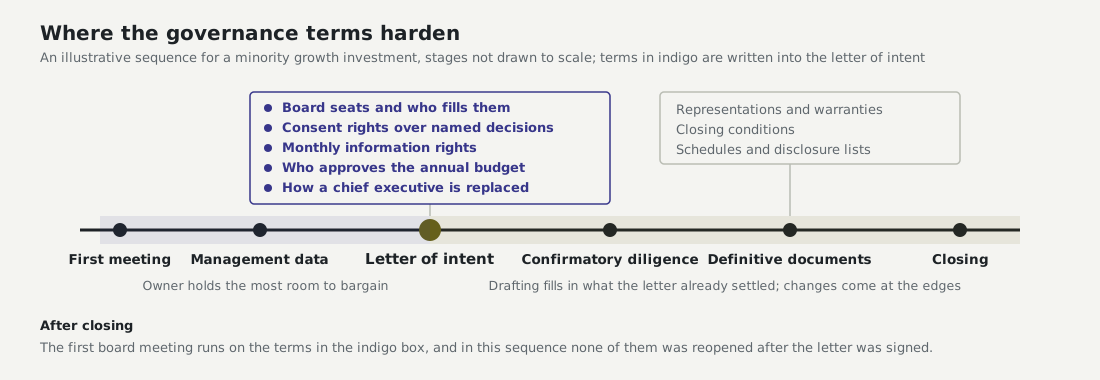
The owner had read the price aloud with some pleasure, and the first two pages of the letter went quickly after that. On page three he slowed down. The paragraph under the heading Governance said the board would have five seats, two named by the investor, and then listed eleven decisions the company could not make without the investor’s written consent. He read the list to the end. The last item was the hiring, firing or replacement of the chief executive officer, and he was the chief executive officer.
Nobody at the table said anything for a while. His chief financial officer turned a pen end over end. Then the owner put the page flat on the table, looked at me, and asked the question every owner asks at that point: this whole letter is nonbinding, isn’t it?
It was, in the sense his counsel meant. Almost nothing in a letter of intent can be enforced except a few housekeeping clauses. I answered him honestly anyway. The page in front of him would not bind him in court. It would bind him in practice, because in every deal I have seen, the governance paragraph in the letter becomes the governance section of the final documents with its wording barely changed.
What the page actually settles
A letter of intent for a minority growth investment usually runs three to six pages, and most of it is about money: the price, the form of the security, the conditions for closing. The governance paragraph is shorter than any of those sections and does more lasting work. It decides four things that will shape the owner’s life for as long as the investor holds the stake.
The first is the board: how many seats, who fills them, and who chooses the chairman. The second is the consent list, the set of decisions that need the investor’s approval even when the investor holds a minority of the shares. The third is information, what reports the company owes and how often. The fourth, sometimes written into the consent list and sometimes on its own, is how a chief executive can be removed.
Each of those terms is short to write and expensive to reopen. Once both sides have signed a letter that says two seats of five, counsel on each side draft two seats of five, and a request later for a different number reads as a renegotiation of the deal itself. The owner who waits for the definitive documents to argue about the consent list will find that the argument has already been lost, politely, weeks earlier.
The mechanics outside the company follow the same page. When a board changes officers after closing, the company has to update filings that regulators rely on. Texas requires every company that drills, operates or services wells to maintain an organization report with the Railroad Commission, and an amendment that only changes the named officers or agents costs nothing to file.1 The form is simple. The decision that makes someone file it was usually made in the letter.
The case for a short letter
Plenty of experienced people would tell that owner to relax, and some of them are investors. A letter of intent exists to find out whether two parties agree on the essentials. Governance, on this view, is a detail best settled later by counsel who have seen the diligence, and a long letter that tries to settle everything wastes weeks on points the two sides would agree on anyway. It also signals mistrust at the one stage where trust is still being built. Better, they say, to write “customary protective provisions” and move on.
My own position is the opposite, and I hold it firmly enough that an experienced director could fairly argue with me about it. I think the consent list should be written out in full in the letter, item by item, with any dollar thresholds stated, and I think an owner should spend more of his negotiating attention on that paragraph than on the price. The price is one number, and he will read it every day. The consent list is a set of rules about how he will run his company, and he will meet each rule for the first time in the middle of a hard quarter.
Customary is where owners get hurt. What one investor considers a customary provision another considers aggressive, and the phrase lets each side imagine its own version until the drafts arrive. By then the owner has told his employees, turned away other suitors and spent money on counsel. He has less room than he had at the table, and both sides know it.
The thresholds matter as much as the items. Take a hypothetical service company that bills $40 million a year. A consent right over any capital spending above $250,000 outside the approved budget sounds reasonable in a letter. In a company that buys pumps and trucks, it can mean a board call every time equipment fails in the field. The budget itself is fragile in this business. The Energy Information Administration notes that supply and demand for oil respond slowly to price in the short term, so it can take a large price change to bring them back into balance,2 and a budget written in one price environment is often living in another by the third quarter. A consent right tied to that budget needs a threshold that allows for it.
The same logic applies to the capital itself. Growth equity as a form of financing gives an investor a say without a majority, and the consent list is the written form of that say. An owner weighing it against a bank loan should read the governance paragraph beside the covenants in the loan agreement, a comparison I work through in the essay on paying down debt or buying the truck.
Where I have been wrong
I have held this rule too tightly. On more than one occasion I pressed for a long, precise consent list in a letter and got it, and then watched the list do exactly what the owner had feared. A capital threshold set in a good year turned into a weekly approval routine in a bad one. A consent right over new customer contracts above a certain length, meant to protect against one large and risky commitment, ended up covering routine master service agreements that the company signed every month. All of it cost management time and some goodwill, and in each case the problem was a term I had wanted in the letter precisely so that nobody could argue about it later.
The lesson I took is narrower than the rule. Writing governance terms out early is right, but a threshold written early is a guess about a company the investor has not finished learning. I now try to pair every numerical threshold with a plain sentence saying the board will revisit it after the first annual budget, and I say that in the letter too.
There is also a case my rule does not handle. When an owner has more than one investor interested, a long governance paragraph can make one letter look harsher than another that says less and will ask for the same things later. I do not have a good answer to that, beyond telling the owner, as clearly as I can, what the shorter letter is likely to become.
Timing shaped much of how I think about this, and I owe that to the years I describe in what energy banking taught me about timing. The rest of my background is set out on the career page. None of this is new to Texas. The bankers and families in the Dallas history of oil money settled who would sit at the table before they settled much else, and the other pieces in the essays on energy capital keep returning to that order of business.
The owner signed the letter that week, with two changes to the consent list and none to the price. Years later, at a board dinner, he took a folded photocopy of that third page out of his jacket. He said he had kept it because it was the only page of the whole deal that had turned out to matter.
References
-
Railroad Commission of Texas, Summary of Requirements and Responsibilities ↩
-
U.S. Energy Information Administration, Oil prices and outlook ↩