The chief executive unrolled the map across the board table and weighted the corners with two coffee cups and a stapler. It showed a second basin, a circle drawn around a town where the company meant to open its next yard, and a row of pins marking the operators it expected to serve there. The plan said the yard would open in July. The calendar on the wall said mid April.
The map was good, and the operating plan in the board packet matched it line for line: revenue from the new district beginning in the third quarter, a ramp through the end of the year, equipment already ordered.
I asked a question that deflated the room a little. I asked to see the payroll register for the prior six months, by role, with hire dates. Finance produced it, because every company keeps one, and it came up on the screen a few minutes later.
It showed two new estimators and a regional sales manager, all hired since January. It showed no new mechanics, no yard manager, no supervisor with experience in the new basin, and a field headcount that had not moved in half a year. The company had hired the people who find work. It had not hired a single person who does it.
What a payroll register actually records
A plan is a statement of intention, and intentions are cheap to revise. Payroll is a record of commitments that somebody has already made, one person at a time, with a start date and a rate. Nobody hires a mechanic because a slide says so. They hire him because a manager believes, strongly enough to sign an offer letter, that there will be equipment for him to keep running.
That is why I have come to read the payroll register before I read the budget, and to read it by role rather than in total. Total headcount tells you almost nothing. A company that added twelve people could be building a district or feeding an office. The mix tells you where management’s actual belief sits, and the timing tells you how far ahead of the work they are willing to spend.
For a service company the order of hiring for a new district is not a matter of taste. Someone has to run the yard before the trucks arrive. Mechanics have to be in place before the equipment can be kept on location. Supervisors who know the new customers must be hired before the crews, because crews without them are just expensive men waiting for instructions. Sales can come first or last; it depends on whether the work is already promised. When the payroll runs in a different order from the plan, one of the two documents is wrong, and it is rarely the payroll.
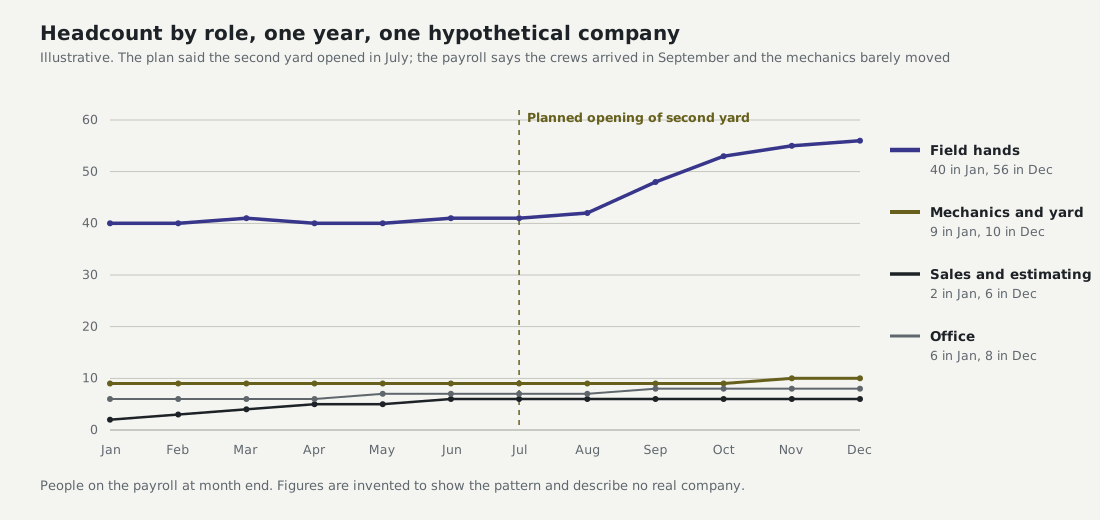
The chart above is invented, but it has the shape I see most often. Sales rises from the first month. Field hands stay flat for three quarters of the year and then arrive in a rush, well after the date the plan gave for opening. Mechanics barely move at all, which means the equipment in the new yard will be maintained, if at all, by people who were already fully occupied in the old one.
A position follows from this that an experienced director can fairly oppose. I think a board of a private service company should see a hiring schedule by role, twelve months forward, alongside the budget, and should ask about it at every meeting until the company is well past its next expansion. Many directors would call that meddling. They would say that hiring below the executive level belongs to management, that a board which reviews the number of mechanics has stopped governing and started operating, and that good chief executives resent it for good reason. I understand the objection and I have made it myself about other things. My answer is that a board does not have to approve the hires to learn from them. It only has to look. The register shows which parts of the strategy management already believes in enough to pay for, and a director can get that nowhere else.
The history of this industry argues for paying attention. Oilfield employment moves hard in both directions. The Handbook of Texas records that a third of the state’s oil and gas employment disappeared between 1982 and 1994.1 In a boom the problem runs the other way: a cost study commissioned by the Energy Information Administration found that well costs rose from 2006 to 2012 as the drilling and service industries ramped up capacity.2 In both kinds of year the first place the truth shows up is the payroll, months before it reaches revenue.
Where the register misleads
The register has blind spots, and I have been caught by them.
The largest is contract labor. A company that fills its new district with crews from a staffing firm or a subcontractor will show a flat payroll and a rising payables line, and a director reading only the register will conclude that nothing is happening. Some companies do this deliberately and sensibly, to test a market before committing to it. Any honest reading has to put the vendor ledger next to the payroll.
The second is that a hire is only a beginning. The same study credited much of the cost improvement after 2012 to more efficient rigs and greater completion crew capacity, which is to say more work from the same people.2 A company that trains its existing hands to run more jobs per week may be expanding faster than one that doubles its headcount, and its register will look timid.
And I have misread the thing outright. I once pressed a management team hard about a hiring freeze in a district I thought they were abandoning. They were not. The district manager had decided, correctly, that the crews he had were underused, and he wanted to prove he could fill them before he asked for more. I read discipline as retreat, said so at the meeting, and it took most of a year to undo the impression that the board did not trust him. The register had told me the truth about the numbers. I had supplied the wrong story.
So payroll is a prompt for me, never a verdict. When the mix of hires and the plan disagree, I ask management which one is right. Usually they know. Sometimes the question is the first time anyone has put the two documents side by side.
In the meeting with the map, the answer was honest and a little uncomfortable. The chief executive believed in the new district. His operations manager did not, and had quietly declined to hire anyone for it until the first contract was signed. Both of them were acting in good faith. Neither had told the other. The yard opened in October, not July, with a supervisor recruited from the new basin and two mechanics transferred from the old yard, and it did well. The plan would have been fine if it had been written by the man doing the hiring.
What a buyer learns from a roster is one reason I argue for care in selling to a larger competitor, and equipment lenders read the same signals with other interests, as the essay on lenders explains. The practice behind these pieces is on my work page, the terms I lean on are defined under oilfield services and growth equity as a form of capital, and this city’s long tie to the business runs through what Dallas built with oil money. The rest of the series is on the energy hub.
Next time a plan comes across the table with a map, a reader should ask for three things before looking at the circle drawn on it: the hire dates of everyone added in the last six months, their roles, and who exactly will run the new place on its first day. If that name is missing, the map is still a drawing.
References
-
Texas State Historical Association, Handbook of Texas, Oil and Gas Industry ↩
-
U.S. Energy Information Administration, Trends in U.S. Oil and Natural Gas Upstream Costs ↩ ↩2