The credit meeting went quiet when I asked, from the end of the table, what the collateral would be worth in a bad year. Nobody had a number. The loan was sound on the day it was proposed, and everyone in the room knew it, but the question was about a different day, and the silence lasted long enough that people started looking at their papers.
I have sat through versions of that silence for more than 35 years, and it is the reason a particular photograph of Dallas holds my attention. It shows a street full of banks at a time when their lending rested on a crop.
A card made for a parlor
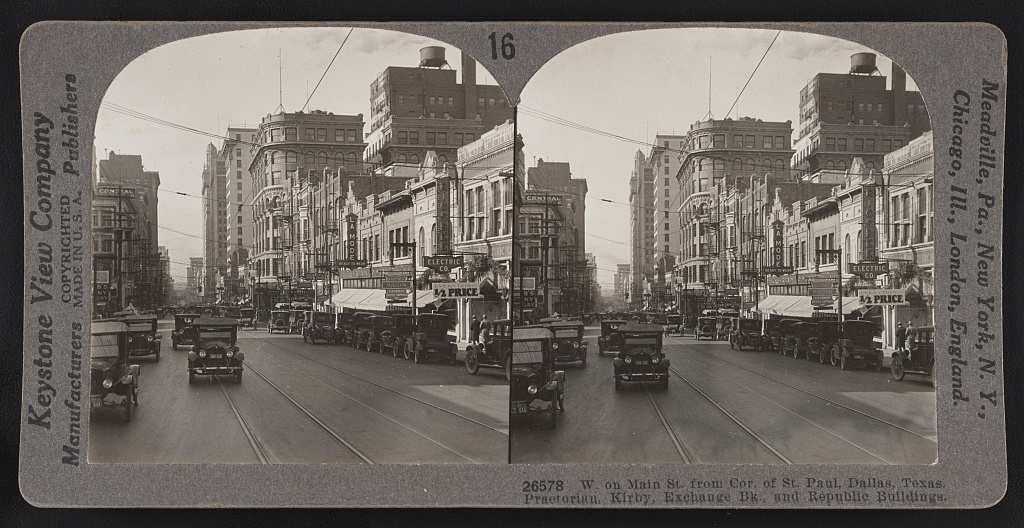
The record is a stereograph card, two nearly identical photographs mounted side by side so that a viewer in a parlor could see them in depth. The Keystone View Company of Meadville, Pennsylvania, published it with a copyright date of about 1926, as number 26578.1 The printed caption reads, in part, W. on Main St. from cor. of St. Paul, Dallas, Texas, and then lists four buildings: the Praetorian, the Kirby, an Exchange Bank and the Republic.1
The frame shows what the caption promises. Automobiles are parked along both curbs, streetcar tracks run down the middle of the street, and signs hang from the storefronts on the right, one of them advertising half price. Tall commercial blocks close the view at the far end.
It was made to sell, as a view to be looked at through a stereoscope by someone who was not standing on Main Street. That purpose shapes what I can take from it. The company chose a view that showed height and traffic, and it named buildings a buyer might have heard of.
Cotton before the towers
The buildings in the frame stand on money that came first from cotton. The Handbook of Texas ties it to the two railroads that reached the town in 1872 and 1873, after which cotton was the leading cash crop of the surrounding country and Elm Street was where it was sold.2 By the turn of the century the city was the world’s leading inland cotton market and still led the world in making cotton gin machinery.2
Railroads changed the trade itself. Compresses that squeezed bales for shipment moved from the ports to interior towns along the rail lines, which let farmers sell directly to buyers for the textile mills and let those buyers ship by rail.3 Every bale that changed hands inland was a transaction someone had to finance.
In Texas after the Civil War, private banks built around cotton exporting and other trade dominated the business, unregulated and unsupervised.4 An 1894 souvenir guide to the city counts five national banks and several private ones in the city, with capital and surplus of $4,000,000, and a full page of the same guide advertises the National Exchange Bank of Dallas with a paid up capital of $300,000.5 The guide is a booster’s book and its figures are its own, but the advertisement at least shows which banks wanted to be seen. In 1893, a year earlier, the national panic had closed five Dallas banks and pushed cotton below five cents a pound.2
A reserve bank for the Eleventh District
Congress established the Federal Reserve System in December 1913, and Dallas was chosen for a Federal Reserve Bank in 1914.62 The district it came to serve covers Texas, northern Louisiana and southern New Mexico, with branches at El Paso, Houston and San Antonio.6 The bank bought the site of its building in 1918 and has occupied the building since March 1921.6
The Handbook credits one Dallas banker, Nathan Adams, with securing the location of the reserve bank for the city.7 It also credits him with programs that averted disaster for the Texas cotton industry in 1907.7 Those two facts belong together. The man who helped carry the cotton trade through a panic was the man who argued that Dallas should hold the reserves of the region’s banks.
The names on the caption
Now back to the card. Of the four buildings it names, I can place two in the Handbook and not the other two. The Praetorian, fifteen stories, was the city’s first steel skyscraper, built in 1907.2 The Republic name matches the bank Fred Florence rose through: the Guaranty Bank and Trust Company became the Republic National Bank and Trust Company in 1922, and he was its president from 1929.8
The Exchange Bank is harder. Adams began his Dallas banking career in 1888 at the National Exchange Bank, the one advertised in the 1894 guide, and Florence worked as a bookkeeper at the American Exchange Bank in Dallas in 1911.78 The caption says only Exchange Bk., and I cannot tell which institution it meant in 1926. I have found no allowlisted source on the Kirby at all, so I leave it unnamed beyond the caption.
What the card cannot prove
The card proves that in about 1926 a publisher thought these four names would sell a view of Main Street. It does not prove that the Republic Building housed Florence’s bank, that the Exchange Bank was either of the two I can name, or that the photograph was taken in 1926 rather than earlier, since a copyright date marks registration and not the exposure. Every one of those links is plausible. None is shown. To close them I would go to a city directory for the middle 1920s, which would list each bank at a street address, and to the building records; I have read neither for this essay, and until I do the card stays a picture of a street and not a map of who lent from it.
That distinction is the whole method. A photograph makes a building feel like evidence, and evidence of what is the question worth asking each time.
From cotton paper to oil in the ground
Here is the argument I would put to anyone who writes about Dallas banking, knowing that some will reject it. I think the move from lending on cotton to lending on oil in the ground was less of an invention than it is usually made to sound. The Handbook says Florence led his bank into commodity lending, above all on cotton and on oil reserves, and that Adams accepted proved reserves underground as collateral for large scale production.87 A banker who had spent years judging a crop he could not see until harvest, against a price he could not set, was already doing the work that reserve lending required. The same judgment moved to a longer calendar. How that worked out once the East Texas field came in is where my essay on oil money in Dallas begins, and the geology and the boom are laid out in the entry on the field itself.
The analogy breaks, and I know where. A cotton crop comes back every year and a reservoir does not. A banker who treated oil in the ground like a renewable crop would have been wrong in the most expensive way, and the silence in my opening meeting was about exactly that difference.
The same question still sits under the work I do now with companies in oil, gas and oilfield services. Photographs and papers from this period are the kind of material the Dallas Historical Society collects, as its reference entry describes. Two private estates of a later generation became a public place on the lakeshore that is now the Arboretum, and the county’s older civic landmark gets its own essay. Every essay in this group is listed under Dallas history.
I have wondered since whether that question cost more goodwill than it was worth. I would ask it again, and I would let the silence run just as long.
References
-
Library of Congress, W. on Main St. from cor. of St. Paul, Dallas, Texas, Praetorian, Kirby, Exchange Bk., and Republic Buildings, Keystone View Company, about 1926. ↩ ↩2
-
Texas State Historical Association, Handbook of Texas, Dallas, TX ↩ ↩2 ↩3 ↩4 ↩5
-
Texas State Historical Association, Handbook of Texas, Cotton Culture ↩
-
Texas State Historical Association, Handbook of Texas, Banks and Banking ↩
-
Library of Congress, Souvenir guide of Dallas, 1894, pages 17 and 18. ↩
-
Texas State Historical Association, Handbook of Texas, Federal Reserve Bank of Dallas ↩ ↩2 ↩3
-
Texas State Historical Association, Handbook of Texas, Adams, Nathan ↩ ↩2 ↩3 ↩4
-
Texas State Historical Association, Handbook of Texas, Florence, Fred Farrel ↩ ↩2 ↩3