On my table lies a printout of the Handbook of Texas article on Nell Goodrich DeGolyer, and one paragraph near the end is doing most of the work. It describes a forty four acre estate called Rancho Encinal on White Rock Lake, a thirteen room house completed in 1940, a will that left the house to Southern Methodist University, and a later transfer to the city of Dallas, which used it to show the gardens she had planned.1 Beside it I have the history page of the Dallas Arboretum and Botanical Garden, which tells the same story from the other end.2
The research problem is ordinary. I want the sequence by which a private estate became a public institution, with each step dated from a source I can name. Two sources, each written by someone who cared about the place, turn out to be enough to show where the sequence is firm and where it is only familiar.
Two houses and a lake
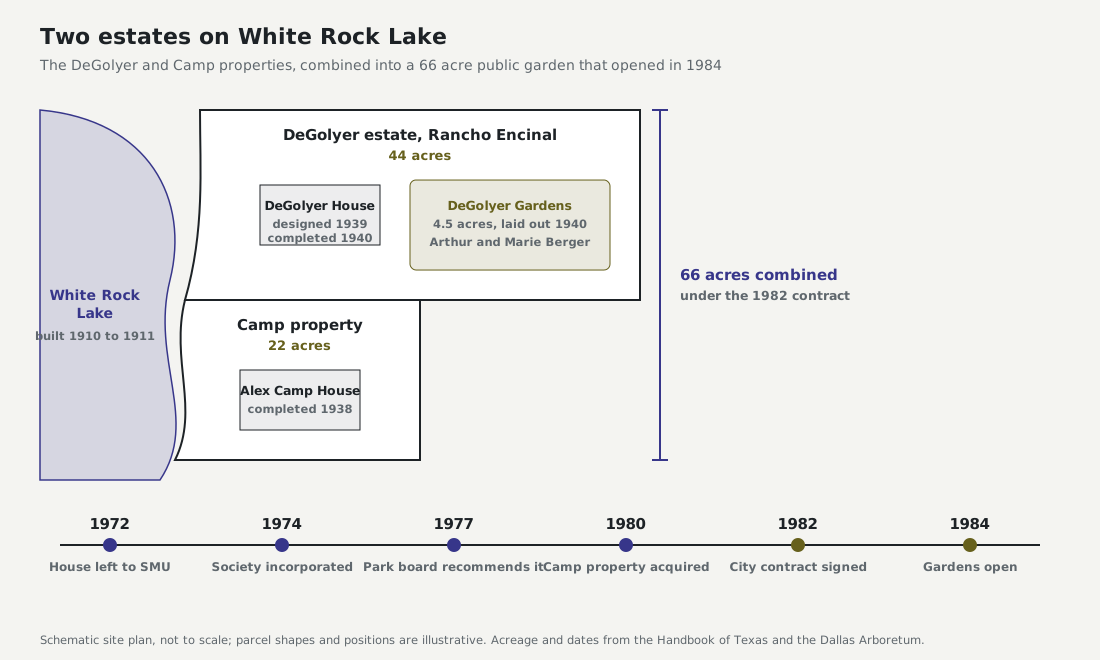
The lake came first. Dallas began building White Rock Lake in 1910 after a water shortage, finished it in 1911, and in the early 1930s the park board, with help from the Civilian Conservation Corps, began turning the shore into a municipal park.3 Houses followed the water.
The Arboretum’s account says the DeGolyers bought a property then in use as a 44 acre dairy farm, called Rancho Encinal for its live oaks, and that their house was designed in 1939 by the architects Denman Scott and Burton Schutt.2 Arthur and Marie Berger laid out the four and a half acres of gardens in front of it in 1940, and the magnolia allée, the sunken garden and the octagonal fountain survive from that plan.4 Next door stood the Alex Camp House, designed by John Staub and completed in 1938, one room deep throughout so that its living rooms and bedrooms each had three exposures.2
Everette DeGolyer, the geophysicist whose work with the reflection seismograph changed how oil was found, had moved to Dallas in the 1930s.5 How money of that kind came to be lent and held in Dallas at all is a thread I follow in my reading of the Main Street banks.
The order of events
Here is the sequence as the two sources give it. Nell DeGolyer lived in the house until her death in 1972, and it passed by her will to the university.1 In 1974 the Dallas Arboretum and Botanical Society adopted bylaws and incorporated as a nonprofit.2 In 1977 the city park board recommended the grounds of the DeGolyer estate, which the city had bought from the university, as the site for a botanical garden, and asked the society to raise the first costs.2 By 1980 the society had raised over $1 million and acquired the neighboring 22 acre Camp property.2 In 1982 the city and the society signed a contract creating a garden on the combined 66 acres, and the gardens opened to the public in 1984.2
The Handbook’s Dallas article names the arrangement that resulted: the Arboretum, like the zoo, is operated under contract by a nonprofit.6
Where the two sources part
The disagreements are small and worth recording. The Handbook gives Nell DeGolyer’s birth year as 1886; the Arboretum gives 1887.12 The Handbook calls the house Spanish Colonial Revival and dates its completion to 1940; the Arboretum calls it Latin Colonial Revival and dates its design to 1939.12 Those can both be right, since a house designed in one year can be finished in the next, and a style name is a matter of taste. The birth year cannot be both, and I would not print either without a third record.
On acreage they match, 44 in both, and a figure reached separately by two writers with different aims is worth more to me than either alone.12 They also agree that the city, and not the university, ended up holding the property.12
What a contract changed
My own reading of this sequence is one that some supporters of the garden would dispute. I think the decisive act was the 1982 contract, not the bequest and not the purchase. A will moved a house. A purchase moved title. The contract settled who would pay, who would plant and who would answer for the place over decades, and without that the estate could have stayed a city property with a lawn. Donors are remembered on plaques. Contracts are remembered by nobody, and they are what turn a gift into an institution.
I should say plainly that I am a founding member of the Dallas Arboretum Foundation, as the page on my civic ties notes, so I read these documents with an interest of my own. That interest is one reason I rely on the Handbook where it can check the Arboretum’s page. The garden’s own summary is in the reference entry on the Dallas Arboretum, and the historical society’s move into a centennial monument is examined in a companion piece on the Hall of State. The society that runs that building has its own record in the entry on the Dallas Historical Society.
My method has a limit here that I have not solved. For the years from 1974 to 1982 my main source is the institution’s own history page, and the park board minutes and the contract itself are papers I have yet to see. An institution tells its founding in the order that makes sense afterward. Courthouses suffer from it too, as my piece on the 1892 courthouse argues, while the full set of Dallas pieces is listed on the hub for this subject.
What the record still cannot tell me is the one thing I most want to know: who decided, and when, that the Camp property belonged in the garden at all, and what the city would have done with the DeGolyer house if nobody had asked.
References
-
Texas State Historical Association, Handbook of Texas, DeGolyer, Nell Virginia Goodrich ↩ ↩2 ↩3 ↩4 ↩5 ↩6
-
Dallas Arboretum and Botanical Garden, About the Dallas Arboretum ↩ ↩2 ↩3 ↩4 ↩5 ↩6 ↩7 ↩8 ↩9 ↩10 ↩11
-
Texas State Historical Association, Handbook of Texas, White Rock Lake ↩
-
Dallas Arboretum and Botanical Garden, DeGolyer Gardens ↩
-
Texas State Historical Association, Handbook of Texas, DeGolyer, Everette Lee ↩
-
Texas State Historical Association, Handbook of Texas, Dallas, TX ↩