The call came on a weekday afternoon from a friend who had just walked through the Hall of State for the first time. He wanted a quick answer to a simple question. How many cities had wanted the Centennial, and what did Dallas pay to get it? I told him I would call back in ten minutes. It took me most of the evening, because the first two sources I opened disagreed on both halves of his question.
Three cities or four
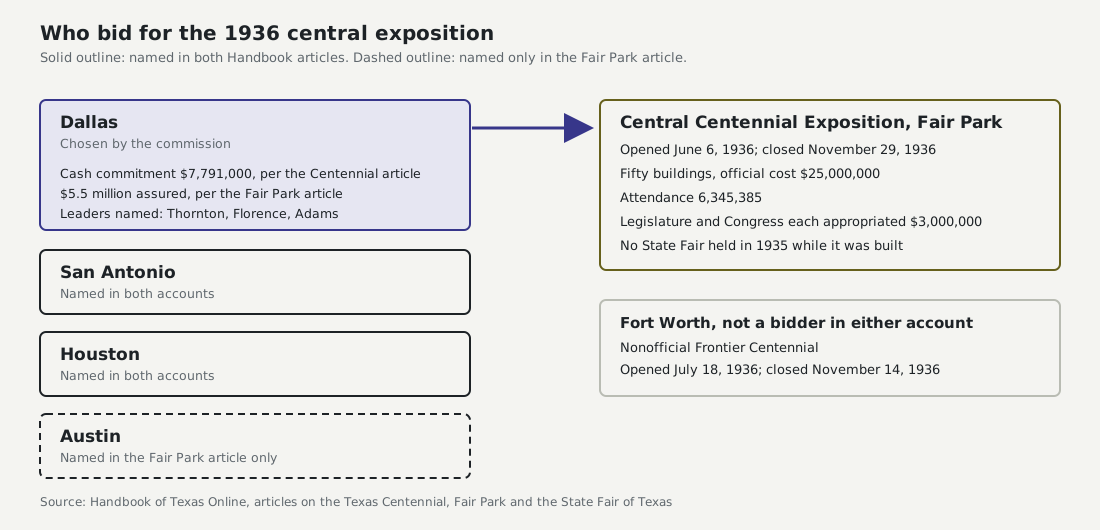
The Handbook of Texas article on the Texas Centennial says three cities competed to host the central exposition: Dallas, San Antonio and Houston.1 The Handbook article on Fair Park lists Austin, with Houston and San Antonio, among the cities Dallas outbid.2 One list has three names and the other has four.
I do not think either author was careless. Austin may have made an early approach that one writer counted as a bid and the other did not, or the word competed may be carrying a stricter meaning in one article than outbid carries in the other. I have no record in hand that settles it. So on the diagram for this page, Austin appears with a note saying which article names it, and nowhere do I say how many cities bid without saying who counted.
Two sums of money
The dollar figures diverge further. The Centennial article says the commission chose Dallas because it offered the largest cash commitment, $7,791,000.1 The Fair Park article says Dallas assured the Centennial Committee $5.5 million of public and private money.2
These are close enough to be about the same bid and far enough apart that I would not treat them as one number. A commitment and an assurance may measure different things, or one may count money the other leaves out. When a board sees two figures for the same deal in two memos, averaging them helps nobody; the useful move is to ask each author what went into the total. With both articles I can only report what each says and cite it.
The same caution applies to the building program. The Fair Park article dates the start of work to October 1935 and gives eight months to finish it, with twenty one of fifty buildings permanent.2 The Handbook’s article on George Dahl, the exposition’s chief architect, says the complex was completed in nine months and describes twenty six buildings by ten firms.23 The counts can be reconciled if they count different things. The months are harder.
Who made the offer
On the question of why Dallas won, the articles agree, and that agreement is the part I trust. The Centennial article names three reasons: the largest cash offer, the existing State Fair grounds with room to expand, and unified leadership headed by the bankers Robert L. Thornton, Fred F. Florence and Nathan Adams.1 It also says plainly that Dallas had the least historical background of the three.1 The Fair Park article credits the persistence of a Dallas group that had formed a corporation for the purpose.2
The individual articles fill in the roles. Thornton was president of the Dallas Chamber of Commerce from 1933 to 1936 and served as a director of the exposition.4 Florence was president of the Texas Centennial Central Exposition in 1936.5 The State Fair article says Fair Park was selected in 1934 largely through Thornton’s efforts, and that no fair was held in 1935 so construction could begin.6
My own reading is blunter. Dallas won the Centennial for the same reason a well organized buyer wins a contested sale: one group with authority to commit, a site already in hand, and money counted before the meeting. Historical claim to the anniversary counted for less than any of those. That answer can sound mercenary, and a San Antonio partisan would say the celebration went to the wrong city. He may be right about the celebration. He is wrong about the auction.
The group did not dissolve afterward. In 1937 Thornton organized the Dallas Citizens Council, whose founding members included Adams and Florence, the two men who had worked beside him on the Centennial.7 The council limited its membership to heads of large businesses who could commit resources without asking anyone.7 It is hard to read that rule without seeing the Centennial bid behind it.
What the articles agree on
Every figure after the award is consistent. The legislature and Congress each appropriated $3,000,000.1 The central exposition, with fifty buildings and a cost of $25,000,000, opened in Dallas on June 6, 1936, and closed on November 29, with attendance of 6,345,385.1 Fort Worth ran its own nonofficial Frontier Centennial from July 18.1 The grounds that made the offer possible get their own treatment in the piece on Fair Park before 1936, and the permanent buildings are summarized in the Fair Park and Hall of State entry.
Where the papers are
The records that would settle the disagreements exist. The Dallas Historical Society’s archive at the Hall of State includes the papers of the 1936 Texas Centennial Commission.8 I have not worked through them, and I would not publish a single corrected figure until I had. My connection to the society is on the civic page. A county courthouse makes the same point on a smaller scale, as my study of Old Red argues: the building stays and the paper explaining it has to be found. Another group of newcomers who made their way in Dallas, much earlier, appears in the La Reunion study, and every title in the set is on the Dallas history page.
I called my friend back after dinner. I told him three or four cities, depending on whom you read. Then I gave him the number that decided it, the one the Centennial article attaches to the choice itself: $7,791,000.1
References
-
Handbook of Texas Online, Texas State Historical Association, Texas Centennial. ↩ ↩2 ↩3 ↩4 ↩5 ↩6 ↩7 ↩8
-
Handbook of Texas Online, Texas State Historical Association, Fair Park. ↩ ↩2 ↩3 ↩4 ↩5
-
Handbook of Texas Online, Texas State Historical Association, Dahl, George Leighton. ↩
-
Handbook of Texas Online, Texas State Historical Association, Thornton, Robert Lee. ↩
-
Handbook of Texas Online, Texas State Historical Association, Florence, Fred Farrel. ↩
-
Handbook of Texas Online, Texas State Historical Association, State Fair of Texas. ↩
-
Handbook of Texas Online, Texas State Historical Association, Dallas Citizens Council. ↩ ↩2
-
Handbook of Texas Online, Texas State Historical Association, Dallas Historical Society. ↩