I spread the two sheets across the screen side by side, the way you would unroll a plan on a table and weight the corners. They are sheets 85 and 86 of the Sanborn fire insurance atlas of Dallas for 1899, now at the Library of Congress, and together they hold the fairgrounds in East Dallas.123
Sheet 85 carries the name in tall italic letters across the middle: Texas State Fair & Dallas Exposition Association Grounds.1 Sheet 86, drawn by the same hand for the same atlas, drops two words and calls it the Texas State Fair & Exposition Association Grounds.2 Before I had read a single building, the map had told me that nobody in 1899 was quite sure what to call the place.
The buildings on sheet 85 are the show. An Exposition Hall with an arched roof sits at an angle to the street, joined to a many sided Music Hall with galleries on the second and third floors. A long Machinery Hall stands in the middle, and a Carriage and Agricultural Implement Exhibit Hall with towers at its corners lines Armstrong Avenue. There is a poultry exhibit in the shape of a cross, two restaurant booths, a menagerie, a fenced deer park, a secretary’s office and a ticket office at the gate, a baseball grandstand in the far corner, and numbered cattle sheds down one edge. The tracks of the Texas and Pacific run along another.1
Sheet 86 is the business end. It has a grandstand, a smaller club stand, a long building labeled Kings Stable, and fourteen long sheds lettered A through N, laid out in rows, which I take to be more stables. It has swine sheds, more cattle sheds and a long privilege stand for concessions.2 A large share of the ground was given over to animals, and much of that to racehorses.
What the insurer drew and what it left out
A Sanborn map was made for fire insurance, which is why it records roofs and water pipes and tells you nothing about crowds.1 The note I value most on sheet 85 is a small box in one corner: a steam fire engine and hose cart were located there during the fair.1 The underwriter wanted to know that, and so do I. It is a record of what the owners feared.
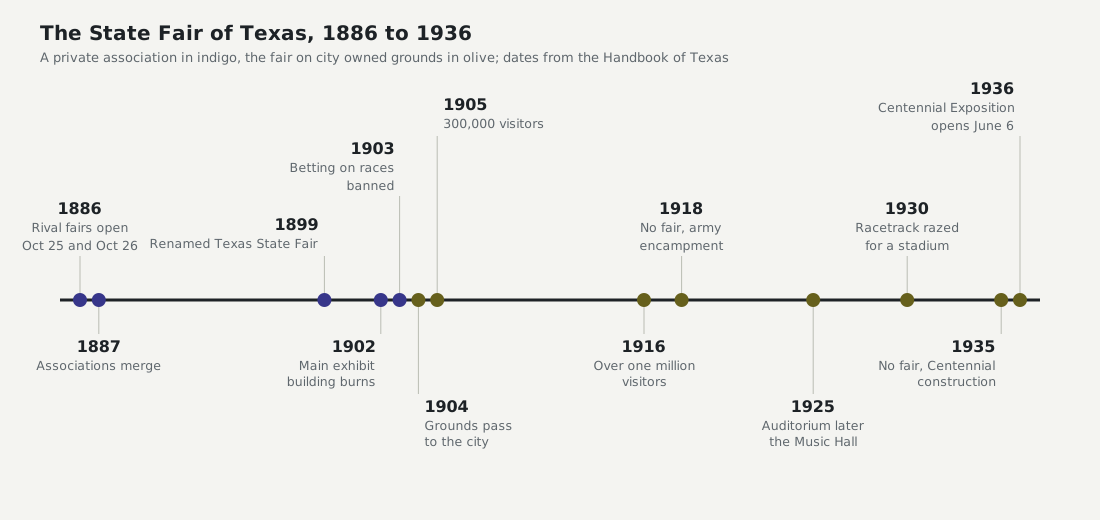
The Handbook of Texas explains why. The Dallas State Fair and Exposition was chartered as a private corporation on January 30, 1886, by Dallas businessmen including William H. Gaston, Thomas Marsalis and John S. Armstrong.4 The directors split over the site. Gaston wanted land in East Dallas; C. A. Keating, speaking for the farm implement dealers, would not agree, and his side chartered a rival fair that opened north of town on October 25, one day ahead of the other.4 The Handbook’s Fair Park article gives the purchase: Gaston bought the original eighty acres for $16,000, deeded them to the new association and took 140 shares of stock, which he later gave to the fair, and the Dallas fair opened on October 26, 1886.3
Both fairs drew crowds and both lost money, and in 1887 they merged as the Texas State Fair and Dallas Exposition.4 That is the name on sheet 85. The Fair Park article says the organization changed its name to Texas State Fair in 1899, the year of this atlas.3 So sheet 85 may preserve the old name, sheet 86 an in between version, and neither the one the directors had just adopted. A map is a survey of a moment, and the moment may be earlier than the date on the cover.
The two Handbook articles do not tell the attendance story the same way. One says the rival fairs of 1886 together drew over 35,000 people a day; the other says attendance at the Dallas fair alone was estimated in excess of 100,000.43 Both can be true, one daily and one for the season, but neither article says which is which.
Where the two agree is the money. Despite a debt of more than $100,000 the merged association bought thirty seven more acres next to the East Dallas site.4 Then the troubles came in order. A grandstand collapsed during a fireworks show in 1900. The main exhibit building burned to the ground in 1902. In 1903 the legislature banned betting on horse races and took away the fair’s main source of income.4 Looking at sheet 86, with its stables and its two stands, I can see how much of the operation the ban reached.
I cannot tell which building on sheet 85 was the one that burned. The State Fair article speaks of the main exhibit building; the Fair Park article says the exposition buildings burned.43 The arched Exposition Hall is the obvious candidate, and obvious candidates are how errors get into print. The Music Hall on this map is also a trap. The Handbook describes an auditorium completed in 1925 that was eventually known as the Music Hall.4 Same name, different decade, and almost certainly a different building. I would not join them without a record that does.
Here is the judgment I would defend against most of the businessmen I know. The directors were offered $125,000 for the grounds, which would have turned them into a residential subdivision, and they refused it.3 Instead they offered the grounds to the city in 1904.3 A board carrying a six figure debt, a burned building and a lost revenue line, with a cash bid on the table, has one conventional answer, and they did not give it. They gave up ownership to keep the use. I think they were right, and the next fifteen years say so: 300,000 people came through the gates in 1905 and more than a million in 1916.4 A seasoned board member might answer that the city got a valuable asset for the price of a debt, and that the shareholders who had carried it since 1886 were the ones who paid. Both things are true. I would still have voted with the board.
Racing did not end at once. The Handbook’s city article lists horse racing as a major attraction at the fair from 1886 until 1909, which is a useful reminder that a ban on betting and an end to racing are two different events.5 The racetrack complex itself was razed in 1930 to make room for a 46,000 seat stadium later renamed the Cotton Bowl.4 No fair was held in 1918, when the grounds became an army encampment, and none in 1935, when the construction for the Centennial took over.4 How the city won that exposition is the subject of a study of the 1936 bid, and what was built for it is summarized in the reference entry on Fair Park.
Two other records sit behind the map. The Dallas Herald of July 20, 1872, set the Central Railroad barbecue in a grove it described as close to the Fair Grounds, fourteen years before the association was chartered.6 Sarah Cockrell was a member of the Dallas County Agricultural and Mechanical Association in 1868, one of only five women among its hundred odd members.7 Neither record tells me where the earlier grounds were, and I have not found one that does. I note them because the 1886 story is usually told as a beginning, and the paper says Dallas already had a fair ground and a fair habit.
The Hall of State, built for 1936, has been the working home of the Dallas Historical Society since 1938, which is how these grounds came into my own life, as the civic page explains.8 The atlas itself belongs to a family of records taken up in a separate piece on Sanborn atlases, and the sheets could be read the same way as the bird’s eye view in the river essay, as a picture drawn for someone with money at stake. Buildings that outlast the people who put them up are also the subject of Old Red and what Dallas kept, and the full set of these studies is on the Dallas history page.
The terms were simple. The city took the grounds and paid the association’s debt; the fair board kept the right to run the exhibition every fall and paid the city a percentage.3
References
-
Library of Congress, Geography and Map Division, Sanborn Fire Insurance Map from Dallas, Dallas County, Texas, 1899, sheet 85. ↩ ↩2 ↩3 ↩4 ↩5
-
Library of Congress, Geography and Map Division, Sanborn Fire Insurance Map from Dallas, Dallas County, Texas, 1899, sheet 86. ↩ ↩2 ↩3
-
Handbook of Texas Online, Texas State Historical Association, Fair Park. ↩ ↩2 ↩3 ↩4 ↩5 ↩6 ↩7 ↩8
-
Handbook of Texas Online, Texas State Historical Association, State Fair of Texas. ↩ ↩2 ↩3 ↩4 ↩5 ↩6 ↩7 ↩8 ↩9 ↩10 ↩11
-
Handbook of Texas Online, Texas State Historical Association, Dallas, TX. ↩
-
Dallas Herald (Dallas, Tex.), July 20, 1872, page three, Chronicling America, Library of Congress, Dallas herald, July 20, 1872, page three. ↩
-
Handbook of Texas Online, Texas State Historical Association, Cockrell, Sarah Horton. ↩
-
Handbook of Texas Online, Texas State Historical Association, Hall of State. ↩