Eleven thirty at night. I read the figure out loud at my desk because I did not trust my eyes on the scan, and then I read the line around it. The Dallas Herald of July 20, 1872, announced that the Central Railroad would now run a regular passenger train to Dallas every day, leaving Houston at eight in the morning and reaching Dallas at 11:30 that night.1
Fifteen and a half hours from Houston. For a town that had been reached by wagon, that was the news, and the paper printed it under the plain heading of a change of schedule, a few inches from a notice about a doctor’s electric baths.
One issue of the Herald
The single record for this essay is that issue: four pages, a weekly, set in small type and scanned into Chronicling America at the Library of Congress. I read it the way I read a first quarterly report after a big contract closes: the headline is written for the occasion, the numbers for the people who must use them.
The occasion was a barbecue. On the Tuesday before the paper went to press, Dallas celebrated the arrival of the first regular train of passenger cars over the Central from Houston. The Herald says the train came in about midnight the night before, that railroad officials stopped over at Corsicana and came up on a special train in the morning, and that by ten o’clock the public square and the streets were crowded.2 The crowd walked out to a grove near the fair grounds, at the edge of the open prairie, not far from the depot. A brass band opened the ceremonies. John Henry Brown gave the address.2
Brown’s speech, as the paper summarizes it, is what one expects: Texas independence, annexation, the Mexican War, the spread of the country to the Pacific. The crowd, he said, had assembled to honor the completion to this point of one of the great railroad enterprises of the state, and they “hailed the arrival of the iron horse with joyous welcome.”2 Then he did something I did not expect. He pointed to the man sitting on the platform and named him as the pioneer and founder of the city.2
That man was John Neely Bryan, who had come to the Trinity crossing in November 1841 and who, after the war, had presided over a public meeting urging that this very railroad be finished.3 The Handbook of Texas places him on the platform at the welcoming ceremonies in mid July 1872, which matches the Herald.3 It also records that his mind was failing by 1874.3 The newspaper gives him one sentence of eulogy. What the city later made of its founder is taken up in a companion essay, and the reference entry on Bryan sets out the dates.
The vice president of the road spoke next, and he did not talk about destiny. He gave a history of the road’s early difficulties, said the company had never declared a dividend, and said it had lately lowered its rates and meant to deserve the business of this section of the state.2 That is a man who knows the room has been complaining about freight charges. I have heard versions of that speech across many tables, and the tell is always the same: the first thing a monopoly promises on arrival is reasonable prices.
Two smaller items on the same page carry more weight than either speech. One reports that an election in the city had carried, by an almost unanimous vote, a proposition to subscribe $100,000 in twenty year bonds to the capital stock of the Dallas and Wichita Railroad Company.2 The other notes that a telegraph office was about to open.2 A town that has just received one railroad is already voting to pay for the next one, and that tells me what the people of Dallas thought the first line was for.
A second line and a junction
The Central was the Houston and Texas Central Railway, chartered as the Galveston and Red River in 1848 and renamed in 1856. It reached Corsicana in 1871, Dallas in 1872 and Denison in 1873, where it met the Missouri, Kansas and Texas to form the first all rail route from Texas to St. Louis and the East.4 Brown told the barbecue crowd to wish the train onward to the Red River; within about a year it was there.24
The second line came from the east. The Texas and Pacific, the only railroad in Texas to run under a federal charter, placed the 125 miles between Longview and Dallas in service on July 1, 1873.5 The day after, the Dallas Daily Herald described an excursion taken on June 30 out to the new town of Terrell, which it called the present terminus of the Texas and Pacific. The excursion train loaded at the corner of Pacific Avenue and Lamar Street, picked up more passengers at the main depot where the line crossed the Central road, and was out on the prairie by a quarter before nine.6
The crossing is the point. The Handbook’s Dallas article says that with the Central in 1872 and the Texas and Pacific in 1873, Dallas became one of the first rail crossroads in Texas.7 It puts the population at about 3,000 in 1870 and 10,385 in 1880, more than triple.7 It adds that merchants who had opened stores along the Central as its construction crept north settled in Dallas and made their flagship stores there, and that cotton became the region’s cash crop with Elm Street as its market.7 The same years ended the hope of carrying that cotton down the Trinity, a hope followed in the piece on the river port that never came.8
Plenty of Dallas historians would dispute my next claim. The junction, in my view, mattered more than either railroad did. A town at the end of one line is a customer. A town where two lines cross is a place where freight changes hands, and the people who handle freight at a crossing tend to stay, build warehouses and lend money. The barbecue celebrated the Central. The directories of the next decade, if I am right, should show the crossing.
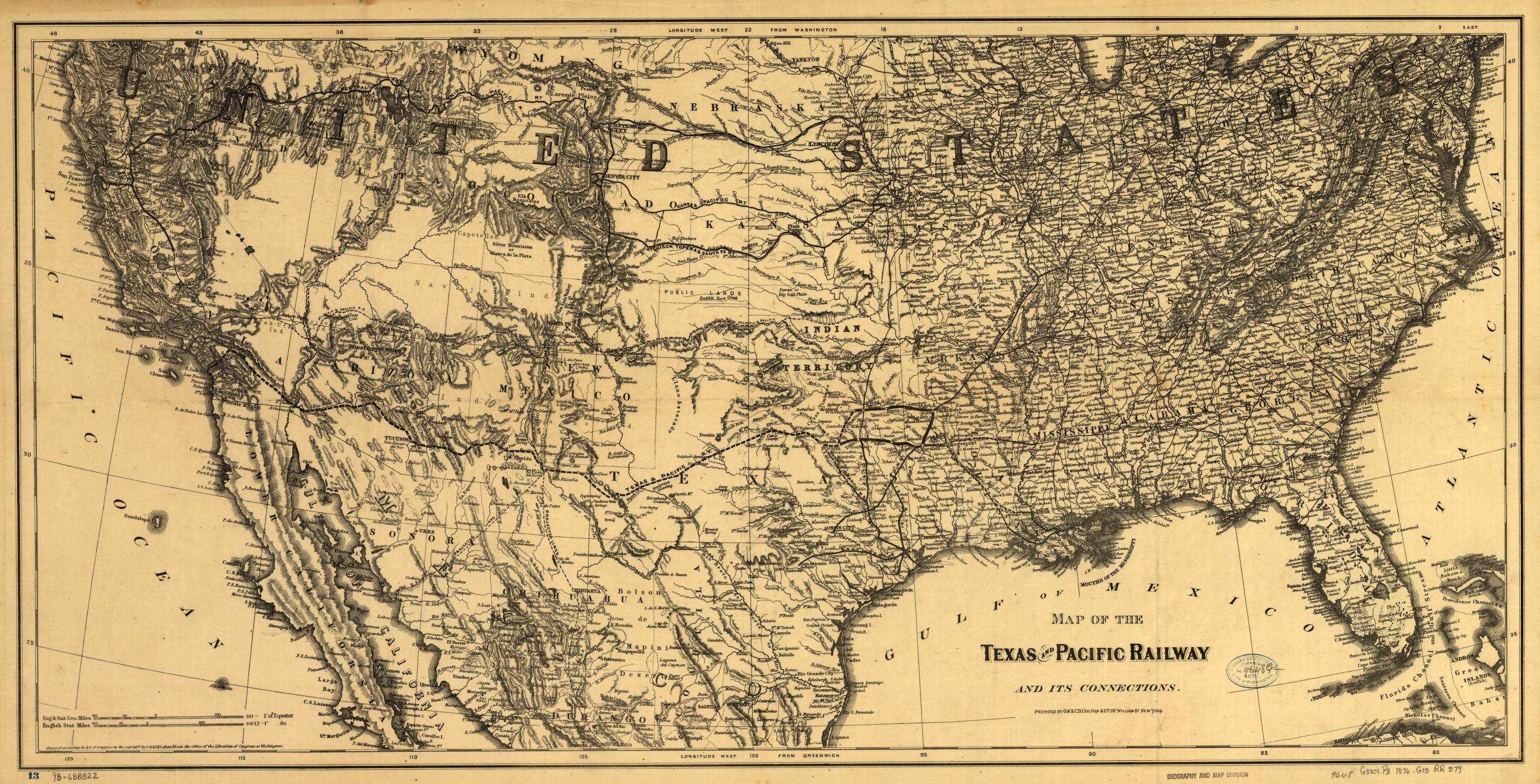
The 1876 map that illustrates this page makes the ambition plain. It shows the whole country with the Texas and Pacific drawn across Texas toward San Diego, and it was prepared for the railway itself.9 Maps like that were sales documents, and I read them the way I read any projection a company prepares about its own future. The line west of Fort Worth was not finished until the next decade.5
The weak spot in this essay is the thing I started with. I have not seen the Herald on paper. I have read a scan and a machine transcription of it, and the transcription garbles a good share of the schedule. I trust 11:30 because the barbecue report, on a different page, has the train arriving about midnight, and two readings of the same fact from different columns are better than one.
Dallas people like to argue over who deserves the credit for bringing the railroads, the town’s promoters or the railroads’ own interest in a crossing on the prairie. The Herald cannot settle that. It shows a crowd, a founder on the platform, a company defending its rates and a town voting bonds for a third line before the band had packed up. The questions it raises about what kind of record survives, and who kept it, are the ones that run through the Dallas history essays and through the archive work of the society described in its reference entry. The public buildings that went up once the railroad money came in are the subject of Old Red and what Dallas kept, and the institutions I work with today are listed on the civic page.
Next time you open a Dallas city directory from the late 1870s, skip the famous names. Count the freight agents, the cotton buyers, the commission merchants and the men listed at the depot. That count, set beside the 1872 schedule, is the closest thing we have to a measure of what the crossing did.
References
-
Dallas Herald (Dallas, Tex.), July 20, 1872, page two, Chronicling America, Library of Congress, Dallas herald, July 20, 1872, page two. ↩
-
Dallas Herald (Dallas, Tex.), July 20, 1872, page three, Chronicling America, Library of Congress, Dallas herald, July 20, 1872, page three. ↩ ↩2 ↩3 ↩4 ↩5 ↩6 ↩7 ↩8
-
Handbook of Texas Online, Texas State Historical Association, Bryan, John Neely. ↩ ↩2 ↩3
-
Handbook of Texas Online, Texas State Historical Association, Houston and Texas Central Railway. ↩ ↩2
-
Handbook of Texas Online, Texas State Historical Association, Texas and Pacific Railway. ↩ ↩2
-
The Dallas Daily Herald (Dallas, Tex.), July 2, 1873, page one, Chronicling America, Library of Congress, The Dallas daily herald, July 2, 1873. ↩
-
Handbook of Texas Online, Texas State Historical Association, Dallas, TX. ↩ ↩2 ↩3
-
Handbook of Texas Online, Texas State Historical Association, Trinity River Navigation Projects. ↩
-
Library of Congress, Geography and Map Division, Texas and Pacific Railway and its connections, 1876. ↩