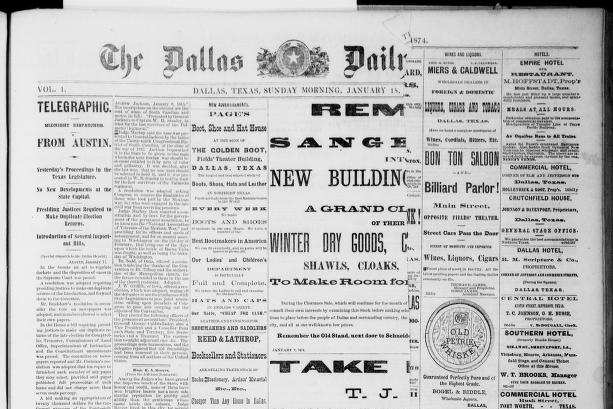
January 15, 1874. Inside the capitol at Austin a company of the Travis Rifles stood in uniform at shoulder arms, drawn up in the space between the Senate and the House, and more armed men waited in the basement. The Dallas Herald’s correspondent, filing that day, reported some excitement and added that nobody was frightened.1 The company had been called out to protect Edmund J. Davis and ended by guarding the inauguration of his successor.2
What moved the men in that hallway off their line was not anything said in the building. It was paper that came over a wire from Washington, and I have spent more time than I expected with the two pieces of it that survive in print.
Two replies, not one
The reference books speak of a single telegram. The Handbook of Texas says that after Coke’s inauguration Davis made one last appeal for federal help, that a telegram from President Ulysses S. Grant declined to send troops to keep him in office, and that Davis resigned on January 19.3 That is accurate as far as it goes. The newspapers show two federal replies, a week apart, signed by two different men and built on two different arguments.
The first came in answer to Davis’s report that the state Supreme Court had declared the December election unconstitutional. The court had announced that decision on January 6, against the administration of the Republican governor.4 Grant’s reply, headed from the Executive Mansion, told Davis that his call for troops was not made in accordance with the Constitution and acts of Congress and could not be granted. Then it turned from law to counsel. The legislature’s election act had received Davis’s own approval, both parties had nominated candidates and campaigned under it, and so, the President asked, would it not be “prudent as well as right to yield to the verdict of the people”?1
It is phrased as a question. A president could have ordered, or threatened, or said nothing at all. This one reasoned with a Republican governor the way a chairman reasons with a chief executive he intends to keep speaking to: here is what I cannot do, and here is what you already agreed to.
The second reply is the one I think ended the standoff, and it does not carry Grant’s signature. It is dated at the Department of Justice on January 17 and signed by George H. Williams, the head of that department. The paper introduced it as the answer to Davis’s second call for military assistance, and Williams wrote that the President had referred that call to him for reply.5 Davis had claimed, citing the constitution, that his term ran into April and that Coke was about to seize the governor’s office. Williams set two provisions side by side. One section of the 1869 constitution gave a governor four years from his installation. The election declaration attached to the same constitution said that officers chosen under it held their terms from the day of their election. More than four years had passed since Davis was elected. On that reading the President found Davis’s right to the office “at least so doubtful” that he did not feel warranted in furnishing troops, and declined.5
How the words reached Dallas
Williams’s text went out from Washington on the afternoon of the seventeenth, and it was set in type in Dallas in time for the Sunday paper of the eighteenth. The Dallas Daily Herald ran it on the front page, in the first column at the far left, under the standing heading for telegraphic news and a subhead calling these the midnight dispatches.5 The headline over it reads that Davis had made another application for troops and that the President had again refused. The paper named the President as the actor even as it printed the name of Williams at the foot of the message, which is exactly how the Handbook tells it a century and a half later.
The same column carries the day’s dispatch from Austin. The legislature had spent the day on bills and on a resolution asking presiding justices, the county officers of that constitution, to send duplicate election returns of the late contest to the governor, and the correspondent had heard nothing about a resignation. Everything, he wrote, was quiet.5 The Constitution of 1876 brought back an elected county judge in place of that arrangement,6 which is the starting point of the essay on county government after 1876.
The rest of the page is advertisements: dry goods, hardware, hotels, saloons and a steady run of Main Street merchants. The telegraph news takes up little more than the column at the left edge. I find that proportion useful. It tells me what a Dallas reader was paying for on that Sunday, and it reminds me that the largest news of the winter arrived as one narrow column in a paper that lived on its advertisers.
Getting it there took a network that was new but no longer novel. Western Union had begun operating in Texas in 1866, and by 1874 it owned eighty nine of the state’s 105 telegraph offices.7 The Handbook ties the wire to the rails from the start, calling the line laid along a railway between Galveston and Houston in 1860 the first permanent telegraph line in Texas, and it dates the rapid growth that followed to the years when transcontinental railroads were crossing the state.7 The pairing of wire and rail is part of why the land given to railroads mattered so much, a story taken up in the essay on railroad land grants before 1876.
The first reply had a slower passage into print. The Dallas Weekly Herald of January 17 reported that Grant had telegraphed Davis, summarizing it in a dispatch from Austin dated January 13, and on the same page printed the full text with an apology: the editors had mentioned it before and, by some oversight, failed to publish it.1 Even the paper that carried the news admits it gave readers the gist before the document.
What I rely on and what I set aside
The position I take here will not please everyone who writes about these weeks. I think the second reply mattered more than the first, and that its authority came from its argument rather than from the office that sent it. Grant’s question was advice, and Davis did not take it. Williams’s letter answered the one claim Davis still had, the April date, on the text of the Texas constitution itself. A man can decline advice. It is harder to hold a building on a reading that the federal government’s chief legal officer has just called doubtful. Two days later Davis resigned.3
A careful reader could reply that I am making too much of a signature. Williams wrote on the President’s instruction, the refusal was the President’s decision, and the Handbook’s shorthand is fair. That is a real objection. My answer is that the reasoning in a document belongs to the person who wrote it down, and the reasoning here is a close comparison of two clauses that a president’s political counsel did not attempt.
The limits of my reading are plain. I have the telegrams only as the Herald set them, through a scan whose optical text garbles several words, including the day on Grant’s heading and the day of the month Davis claimed in April. I have not seen the originals as received in Austin, and I cannot say how Davis read either one. Davis’s full career is laid out in his reference article, and Coke’s in a companion article. A telegram reprinted by an editor is at one remove from its sender, much as the 1867 registration rolls sit at one remove from the men who signed them, and the related documents are collected in my Reconstruction series.
When I wrote about this month for my biography of Coke, the easy sentence was that Grant refused to send troops. I chose to name Williams as the author of the refusal that ended it and to say that he wrote at the President’s direction. It costs a clause and adds a name most readers will not recognize. I would make that decision again, because a document is best credited to the hand that signed it.
References
-
The Dallas Weekly Herald (Dallas, Tex.), January 17, 1874, page two, with the President’s telegram to Governor Davis and dispatches from Austin, Chronicling America, Library of Congress, The Dallas weekly herald, January 17, 1874. ↩ ↩2 ↩3
-
Handbook of Texas Online, Texas State Historical Association, Travis Guards and Rifles. ↩
-
Handbook of Texas Online, Texas State Historical Association, Coke Davis Controversy. ↩ ↩2
-
Handbook of Texas Online, Texas State Historical Association, Ex parte Rodriguez. ↩
-
The Dallas Daily Herald (Dallas, Tex.), January 18, 1874, page one, Chronicling America, Library of Congress, The Dallas daily herald, January 18, 1874. ↩ ↩2 ↩3 ↩4
-
Handbook of Texas Online, Texas State Historical Association, County Judge. ↩
-
Handbook of Texas Online, Texas State Historical Association, Telegraph Service. ↩ ↩2