A retired surveyor who had worked along the old Texas and Pacific line asked me a question I thought would take one sentence. When did Texas start paying railroads in land again after the Reconstruction constitution shut the practice down? I said 1874, because that is the year I had in my notes. He said his own notes said 1873. We were both quoting the Handbook of Texas, and we were both right about what it says.
The Handbook’s general article on railroads states that an amendment of 1874 permitted land grants.1 Its article on land grants for internal improvements says an amendment in 1873 allowed grants of up to twenty sections per mile.2 Same publisher, same subject, a year apart. To choose, I had to rebuild the arrangement the date belongs to.
The state had very little cash and a great deal of land, and it used both. In the early 1850s individual charters promised eight sections of public land for every mile of track, and almost nothing got built. A general law of 1854 doubled the figure to sixteen.2 Money moved too. Six railroads built before the war borrowed $1,816,500 from the Special School Fund at $6,000 a mile, and paid back $4,172,965 in principal and interest; only one line defaulted, and the state foreclosed and sold it.1
Then the door closed. The Constitution of 1869 forbade granting the public domain to anyone but an actual settler, which ended grants to railroads, and it declared forfeit any earlier grant whose conditions went unmet.3 Among the subjects Governor Edmund Davis laid before the legislature on April 29, 1870, as the Legislative Reference Library summarizes them, were limiting state aid to a single line crossing Texas between the Red River and the Rio Grande, controlling railroads built with state subsidies, and relieving defaulted roads of forfeiture if they paid the interest due.4
A rule against land does not stop a legislature that wants railroads. It changes the currency. The charter of the International Railroad Company, granted in August 1870, promised $10,000 in state bonds for every mile completed. When the company came to collect, Comptroller Albert A. Bledsoe refused to sign and register the bonds. The settlement gave the road twenty sections of land per mile instead of the usual sixteen, plus exemption from state taxes for twenty five years.5 The Texas and Pacific, chartered by Congress on March 3, 1871, held a state grant of twenty sections per mile in Texas.6
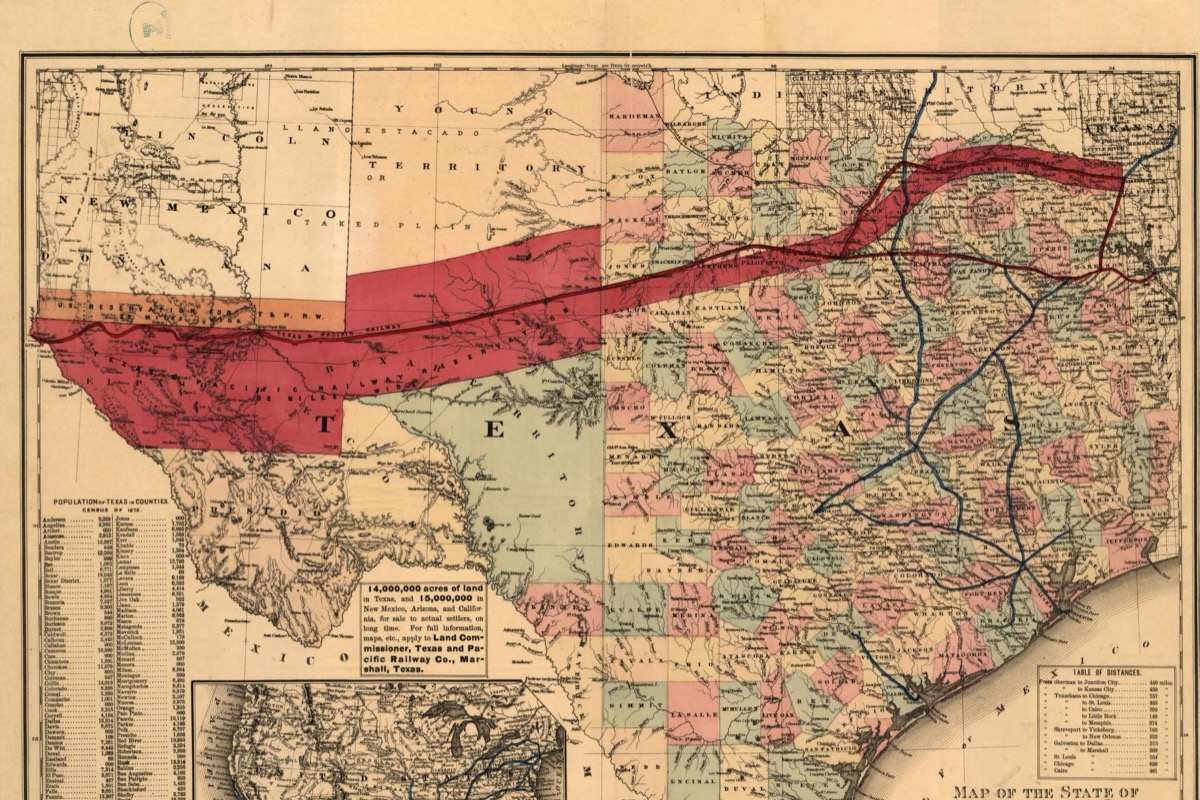
The map at the head of this page shows that grant as its sellers saw it. The red band runs from the Louisiana line to El Paso, and a printed box in the lower left offers 14,000,000 acres in Texas “for sale to actual settlers, on long time.”7 It is an advertisement drawn as a map, and the company never collected that much. Between 1873 and 1881 it built 972 miles and claimed entitlement to 12,441,600 acres, but it received land only for track east of Fort Worth, 5,173,120 acres, because the western line missed the deadline in its charter.6
Here is the method. The two grants I can trace in this period both run at twenty sections per mile. The 1854 law was sixteen. The later law of 1876 was also sixteen.12 Twenty is the ceiling the Handbook attributes to the amendment of 1873.2 A figure that specific does not turn up by accident in two unrelated settlements, so I treat 1873 as the year the rule changed and the general article’s 1874 as either the year it was applied or a slip. I have not read the joint resolution itself or the election record that ratified it, and the Texas State Library and Archives is where I would go next. Until then I write “an amendment of 1873” and footnote the disagreement rather than bury it.
Now the judgment, which a good many people who know this period will dispute. I think the loans were the better bargain for the state and the land was the worse one. The school fund lent $1.8 million and got back more than $4.1 million. The land went out by the section and never came back at a price the state set. The International and Great Northern’s predecessors earned 6,432,000 acres and sold them for a net of about $0.72 an acre.5 The Interstate Commerce Commission later found the Texas and Pacific had realized about $3.00 an acre on its state land.6 Anyone who has sat at a table where one side pays in something other than cash, as I have in my own work, knows the danger: the payer can say the currency was worth little, and the recipient can make it worth more afterward.
The strongest objection is that the land was not really money. Unsettled prairie far from any market had no price until a railroad crossed it, so the state gave away nothing it could have sold. It is where my reading gives way. I have no way to price an acre that had no buyer, and neither did the legislature. What I can say is that the state gave up the power to set the terms, and no record I have read shows anyone in Austin weighing that.
The constitution enters only at the end. The Constitution of 1876 authorized sixteen sections per mile and prohibited grants of money or bonds; a law in the same year, close to the 1854 act, put that into effect.81 In 1882 the legislature repealed it on learning that little unappropriated land remained. By then forty three companies had received 32,153,878 acres.2 The larger document is described in the entry on the Texas Constitution of 1876.
The year matters for a second reason. Davis resigned on January 19, 1874, after President Grant declined to send troops, the episode recounted in the essay on the telegram from Washington.9 An 1873 amendment belongs to the old administration’s last year; an 1874 one to the new government’s first.
I read a roll the same way, as with the registration lists of 1867: find the number only one rule could produce, and let it date the document. More records of these years are on the Reconstruction page.
The question I now ask first of any Texas railroad grant is how many sections per mile it carried, because that number tells me which law wrote it.
References
-
Handbook of Texas Online, Texas State Historical Association, Railroads. ↩ ↩2 ↩3 ↩4
-
Handbook of Texas Online, Texas State Historical Association, Land Grants for Internal Improvements. ↩ ↩2 ↩3 ↩4 ↩5
-
Handbook of Texas Online, Texas State Historical Association, Constitution of 1869. ↩
-
Legislative Reference Library of Texas, Session snapshot, 12th Legislature, 1st Called Session. ↩
-
Handbook of Texas Online, Texas State Historical Association, International Great Northern Railroad. ↩ ↩2
-
Handbook of Texas Online, Texas State Historical Association, Texas and Pacific Railway. ↩ ↩2 ↩3
-
Library of Congress, Geography and Map Division, Map of the state of Texas showing the line and lands of the Texas and Pacific Railway, 1873. ↩
-
Handbook of Texas Online, Texas State Historical Association, Constitution of 1876. ↩
-
Handbook of Texas Online, Texas State Historical Association, Coke and Davis Controversy. ↩