I once walked into a library’s periodical stacks to find the first volume of the Quarterly of the Texas State Historical Association, first issued in July 1897, and stayed an hour longer than I meant to.1 The volumes run down the shelf in a straight line, one per year, and the early ones are full of letters, diaries and memoirs rather than analysis. That was deliberate. At the first annual meeting its president said the job of the membership was less to write a finished history than to supply the facts for one.1
I went there for a date and came away with a research problem about a single word.
The word in its own years
The word is redemption, and its companion, Redeemers, for the Democrats who took the Texas government back from the Republicans, the legislature in 1872 and the whole of it by 1873.2 Before I use a term like that I want to know how the people of the period used it, so I read it where they printed it.
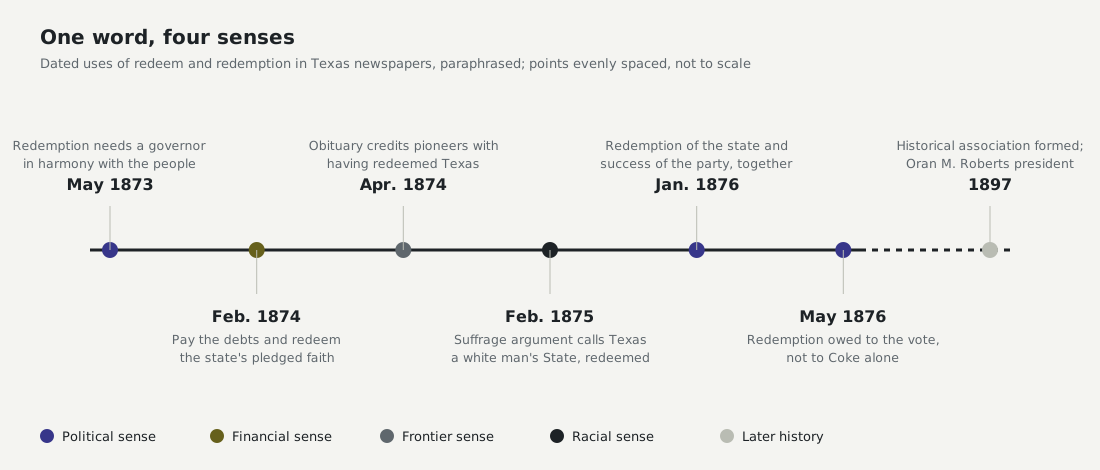
In May 1873, eight months before Richard Coke took office, the Austin Democratic Statesman reprinted an editorial from a Jefferson paper arguing that the entire redemption of the state could not happen until a governor in harmony with the people was elected.3 In February 1874 a Waco paper used the same verb in its financial sense, urging the legislature to pay the state’s debts to the last cent and redeem its pledged faith.4 Two months after that the Statesman praised a pioneer woman’s generation for having redeemed Texas from what it called savage domination.5
By February 1875 the Statesman was arguing that the vote in town and county elections should be restricted to property owners, and it closed with a sentence that shows what the word had come to carry: “Texas is a white man’s State, redeemed by courage.”6 The sentence goes on to name the peoples it was redeemed from, and I will not reprint that part.
In 1876 the Dallas Herald was using the word as settled history. In January it credited a comptroller on the 1873 ticket with contributing to the redemption of the state and the success of the party, in one breath.7 In May it argued with another paper over whether Coke deserved the credit for redeeming Texas, and decided that the redemption was owed instead to the Democratic vote that had swept away what it called Radical rule.8 Within three years the Democrats were quarreling over who owned the word. Nobody in those columns doubted that it was theirs.
The political sense sat on top of the financial one. The same winter that Coke’s supporters were calling their victory a redemption, the treasury was holding warrants it could not pay, as the essay on the debt the new government inherited shows. Salvation and solvency shared a verb.
Who wrote the first histories
The people who used that vocabulary did not hand it to strangers. When the Texas State Historical Association organized in 1897, its members chose Oran M. Roberts to lead them, and the address he gave noted that many of the members had themselves been important figures in the making of Texas history.1 Roberts had served on the Supreme Court after 1873, and his history of the Reconstruction years gave the derisive name Semicolon Court its permanence.9 The reference entry on the association covers its later work, which has been broad and valuable. Its beginning was a meeting of participants.
That matters for the vocabulary because a word used by the winners in 1873 became the word used by the first people to write the story. Writing about the State Police, the Handbook of Texas now reports a charge from newer scholarship: that the first generation of historians of Reconstruction in Texas allowed a prejudice against Republican organizations into their conclusions.10 The word redemption is one of the places where that bias would sit most comfortably, because it does its arguing before a sentence has begun.
The rule I follow
My rule is simple. When I write about the period in my own voice I use neutral terms: the Democrats, the Coke administration, the end of Republican government. When the period’s word is the subject, I quote it and date it, and whenever Redeemers or redemption describes events rather than the words themselves, it goes inside quotation marks.
Here is the part a good historian could fairly contest. The case against me is that Redemption has become the conventional name of an era, the way Reconstruction has, and that quotation marks are a small act of scolding that adds nothing once the reader knows the history. I disagree. Reconstruction describes a program. Redemption describes a verdict on it, and it borrows a theological claim to do so: that what came before was a captivity and what came after was salvation. The newspapers above show that for at least some of its users the verdict was explicitly about race. A label that carries its own judgment should be marked as a quotation, for the same reason I would mark a company’s description of its own results.
Where the rule fails
The rule is not clean. Radical was also a partisan word, and I sometimes use it without marks because the Handbook itself calls Davis’s faction the radical wing of his party.11 Reconstruction itself carried a charge in 1874 that it has since lost. And the marks can make a paragraph fussy enough that a reader stops trusting the writer’s ear. I have no formula for which charged words to fence and which to let go, only the question of whether the word asks the reader to agree with someone before the evidence arrives.
It also fails with sources. The newspapers I can read are the ones that survived and were digitized, and the papers my searches return for these years are overwhelmingly Democratic. A study of word use built on the papers that won is its own kind of survivor’s account, a problem that shadows the registration rolls of 1867 as well, and one I face again in tracing a single delegate through three records.
Readers who want the political sequence first can start with an overview of the Reconstruction decade. Why an energy investor reads county newspapers at all is explained on my about page, and neighboring pieces sit in the Reconstruction collection.
The quotation marks make my sentences a little clumsier, and that is a price I have decided to pay.
References
-
Handbook of Texas Online, Texas State Historical Association, Texas State Historical Association. ↩ ↩2 ↩3
-
Handbook of Texas Online, Texas State Historical Association, Tax Payers’ Convention. ↩
-
The Weekly Democratic Statesman (Austin, Tex.), May 22, 1873, page one, reprinting the Jefferson Democrat of May 10, Chronicling America, Library of Congress, The weekly democratic statesman, May 22, 1873. ↩
-
The Waco Daily Examiner (Waco, Tex.), February 18, 1874, page two, Chronicling America, Library of Congress, The Waco daily examiner, February 18, 1874. ↩
-
The Weekly Democratic Statesman (Austin, Tex.), April 9, 1874, page two, Chronicling America, Library of Congress, The weekly democratic statesman, April 9, 1874. ↩
-
The Weekly Democratic Statesman (Austin, Tex.), February 25, 1875, page two, Chronicling America, Library of Congress, The weekly democratic statesman, February 25, 1875. ↩
-
The Dallas Daily Herald (Dallas, Tex.), January 9, 1876, page two, Chronicling America, Library of Congress, The Dallas daily herald, January 9, 1876. ↩
-
The Dallas Daily Herald (Dallas, Tex.), May 4, 1876, page two, Chronicling America, Library of Congress, The Dallas daily herald, May 4, 1876. ↩
-
Handbook of Texas Online, Texas State Historical Association, Semicolon Court. ↩
-
Handbook of Texas Online, Texas State Historical Association, State Police. ↩
-
Handbook of Texas Online, Texas State Historical Association, Davis, Edmund Jackson. ↩