The governor told the legislature that there was one thing about the treasury he could state as certain, and it was that nothing was in it. He said so in a message dated February 10, 1874, less than four weeks after he took office, and an Austin weekly printed the whole text two days later.1 Of all the opening statements from new management I have read, it is the most candid.
The message was a cover letter. Richard Coke had asked the comptroller of public accounts and the state treasurer for enough information to give the legislature some idea of the state’s finances, and he was forwarding what they sent. He warned that the statements were “not so full as might be desired,” because there had been no time for a proper investigation, but that he believed them correct as far as they went.1 The Fourteenth Legislature had been sitting since January 13 and would stay until May 4, so this was the working paper for most of a session.2
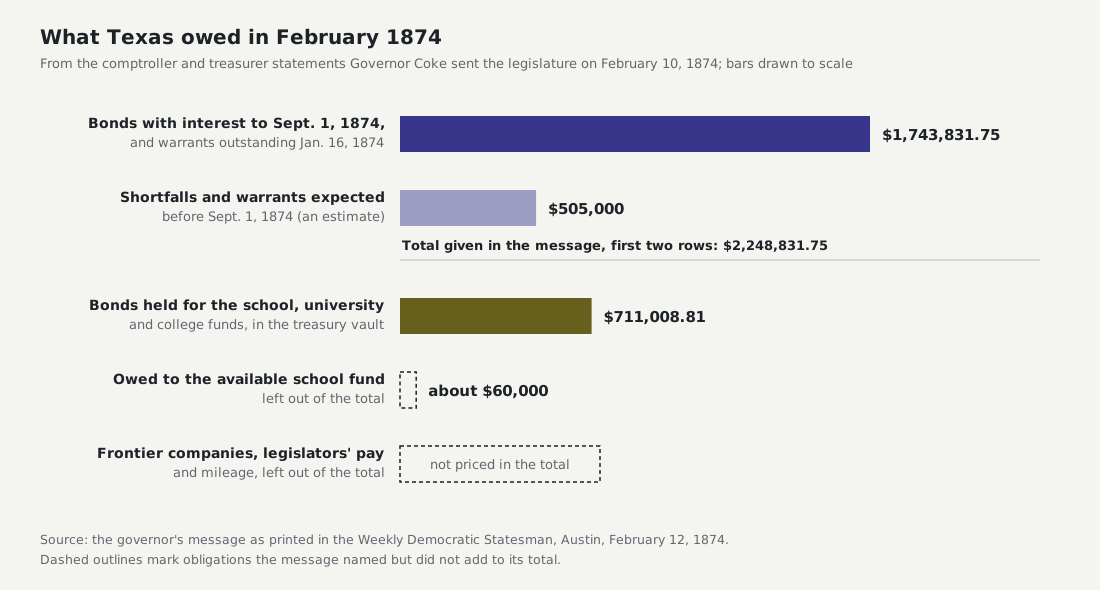
The figures are simple to lay out. Bonds already issued, with interest on them to September 1, 1874, together with the comptroller’s warrants outstanding on January 16, came to $1,743,831.75. To that Coke added the shortfalls in the current year’s appropriations and the warrants expected to accrue before the new fiscal year began on September 1, for a total of $2,248,831.75. The difference, $505,000, was an estimate and was labeled as one. Separately, the state owed $711,008.81 to three of its own funds, the Permanent School Fund, the University Fund and the fund for the Agricultural and Mechanical College, in the form of five and six percent bonds that sat in the treasury vault.1
Then comes the paragraph I would have circled if the statement had crossed my desk as an investor. The treasurer’s books showed $30,078.75 in currency and $94.50 in specie on hand for the expenses of government. Coke explained that the money was not really there. The constitution sent one fourth of revenue receipts to the available school fund; since the fiscal year began only $17,513.89 had been paid to it when about $100,000 was due, and even after the cash on hand was credited to the schools, general revenue would still owe that fund nearly $60,000.1 The balance was a liability wearing the clothes of an asset.
A debt schedule is as useful for its exclusions as for its sum, and this one names its exclusions honestly. The $2,248,831.75 did not include the roughly $60,000 owed to the available school fund. It did not include the pay and mileage of the legislators reading it. And it did not include the cost of the frontier companies Coke’s predecessor had called out by circular letter, for which the governor forwarded a separate estimate from the adjutant general.1 What frontier defense went on to cost is part of the essay on guarding the frontier in 1874.
Two weeks later a correspondent in the same paper, writing under the heading of state finances, took the governor’s numbers and rebuilt them. He added the frontier estimate, the school fund balance and an allowance for pensions, arrived at a total considerably larger than the governor’s, and weighed whether cash should go to current expenses or to warrant holders in order of priority, some of whom had waited two years to be paid.3 I cannot give his total to the dollar. The scan lets me follow his argument but not his figures, and I will not guess at a digit.
The legislature moved quickly on the parts it could act on. A weekly list of new laws printed in March includes an act “to provide money to pay the floating indebtedness of the State,” approved March 4, 1874, an act allowing the governor to sell certain state bonds and settle an account with the firm of Williams and Guion, and a joint resolution, approved March 9, directing the treasurer not to pay certain warrants except out of funds provided for them.4
Here is where I part company with the tone of the message, and I expect an argument. The empty treasury Coke described was in real measure the work of the men who elected him. In September 1871 the Tax Payers’ Convention met in Austin, reported that taxes had risen from $956,850 in 1866 to $2,120,605 in 1871, and advised Texans not to pay the one percent school tax. Taxpayers across the state then obtained injunctions in local courts against collection, and the Handbook of Texas records that the failure to collect crippled the government’s major programs, the schools above all, and hurt its efforts to borrow in the North.5 The Handbook’s history of the period concludes that the charge of high taxes proved the undoing of the Republican government.6
A statement of arrears prepared in January 1874 is therefore partly a record of a successful tax strike. The warrants outstanding were claims that the revenue never came in to meet. The school fund balance was short because revenue had been short. None of that makes the Davis government’s spending wise, and the railroad aid of those years, $10,000 in eight percent bonds per mile for one line, was the kind of promise any lender would question.6 My narrower claim is that a new administration presenting the inherited books has every reason to present them darkly, and the reader of those books has to ask who stopped paying into them.
The strongest objection is that this is hindsight dressed as analysis. The men who resisted the tax believed it was illegal, the state’s own Supreme Court upheld it anyway, and a government that cannot persuade its citizens to pay has a problem that is its own.5 I accept most of that. What I do not accept is reading the February total as a verdict on four years of management without reading the collection record beside it.
Most of my working life has been spent on the capital side of private energy companies, as the notes on my investing work describe, and the first document I ask for after any change of control is the schedule of what the company owes and to whom. This message answers my usual questions unusually well. Which obligations are contractual and which are estimates? Which are owed to outsiders and which to the business’s own reserves? What cash is truly free? Coke’s statement separates all three, and it flags its own estimate in a way I wish more finance chiefs would.
The $711,008.81 owed to the school, university and college funds is the item I would argue about longest. It is easy to treat money a state owes itself as an accounting entry, since the bonds never left the vault. I treat it as debt. The school fund had beneficiaries, and the children counted by it did not become less real because their creditor and their debtor shared a building. A later essay on how the word redemption was used finds the same verb doing duty for paying creditors and for winning elections, which tells you how closely the two ideas sat.
Where my method breaks is in the source itself. I am reading a governor’s summary of two officers’ statements as set in type by a party newspaper, through a scan read by software. The comptroller’s own ledgers sit one step further back, and so does the confused state of the records that Coke himself said only time and investigation would explain.1 Registration rolls such as the 1867 voter lists pass through fewer hands than this statement did.
For the man who signed the message, see Coke’s biographical entry; the four years that ran up these bills are surveyed under Reconstruction in Texas, and more of that winter’s paper waits in this Reconstruction series. His administration, according to the Handbook, went on to cut printing and asylum costs and watched frontier defense eat the savings.7
The rule I take from the page is the one I apply to any inherited balance sheet, stated now as the limit it really is: a statement of what is owed can be no more complete than the list of things its author knew to count, and the first draft of that list always leaves something off.
References
-
The Weekly Democratic Statesman (Austin, Tex.), February 12, 1874, page two, message of Governor Richard Coke of February 10, 1874, Chronicling America, Library of Congress, The weekly democratic statesman, February 12, 1874. ↩ ↩2 ↩3 ↩4 ↩5 ↩6
-
Legislative Reference Library of Texas, Session snapshot, 14th Legislature, Regular Session. ↩
-
The Weekly Democratic Statesman (Austin, Tex.), February 26, 1874, page four, Chronicling America, Library of Congress, The weekly democratic statesman, February 26, 1874. ↩
-
The Weekly Democratic Statesman (Austin, Tex.), March 26, 1874, page two, Chronicling America, Library of Congress, The weekly democratic statesman, March 26, 1874. ↩
-
Handbook of Texas Online, Texas State Historical Association, Tax Payers’ Convention. ↩ ↩2
-
Handbook of Texas Online, Texas State Historical Association, Reconstruction. ↩ ↩2
-
Handbook of Texas Online, Texas State Historical Association, Coke, Richard. ↩