The first note I wrote on the Frontier Battalion was wrong, and it was a mistake I made by trusting a good source too quickly. My card read: January 1874, the Fourteenth Legislature authorizes five companies of Rangers. I had copied it from the Handbook of Texas entry on John B. Jones, the man who would command the force, and I had no reason to doubt it.1 A week later I read the Handbook’s own entry on the battalion, which describes six companies of seventy five men each, organized in 1874 on Governor Richard Coke’s recommendation.2
Five or six, and January or some later month. Neither discrepancy would change the story anyone tells about the frontier. Both of them would have gone into print under my name if I had not gone looking for a third source, so this is an account of how I settled it.
Two careful entries that disagree
The easy move is to average the sources, or to pick the longer entry because it looks more thorough. I did neither. When two summaries disagree, both are usually compressing something older, and the job is to find the older thing.
In an investment memo I treat a disagreement between two analysts the same way. I do not ask which analyst I like. I ask which document each of them was reading, and then I read it myself. Most of the time one of them was looking at a draft and the other at the signed version.
The Handbook entries are careful scholarship, and they list their own sources. What they could not give me was the date and wording of the act itself, which is what the question turned on. For that I wanted something produced in 1874, by the people doing the work, for a purpose that had nothing to do with history.
The oath Jones signed
The Texas State Library and Archives holds the oath of enlistment that Jones swore that spring. It is a short printed form filled in by hand. He swears to obey the orders of the governor and of his officers according to an act of the legislature for raising a battalion for frontier protection, approved April 10, 1874. He signed it on May 19, 1874.3
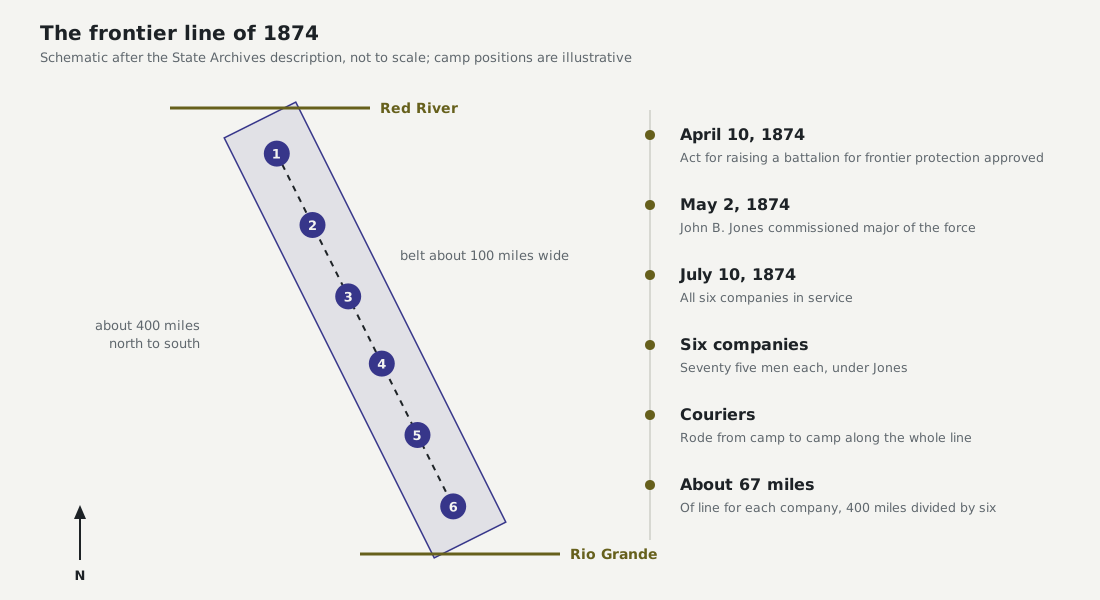
That page settled the date to my satisfaction. A clerk filling in an oath of enlistment has every reason to name the governing statute correctly, because the oath is what makes the man subject to it, and no reason at all to shade the date. The State Archives’ own exhibit on the Rangers gives the same April 10 date for the battalion’s creation and describes it as six companies of seventy five men under Jones.4 The Handbook says Jones was commissioned on May 2 and that all six companies were in service by July 10.2
So the card now reads April 10, six companies. I still do not know what the Jones entry’s January reference was compressing. It may be an earlier bill, or a message, or simply a slip, and I have not been able to confirm which from anything I could read directly. I left the question open on the card rather than guess.
Here is the position I hold that a careful historian could fairly oppose. For a narrow factual question like a date or a count, I will take an administrative form over a historian’s paragraph every time, even an excellent paragraph. The objection is a good one: the historian has read hundreds of forms and I have read one, and a single form can carry its own error. My answer is that I am not asking the form to interpret anything. I am asking it for the one fact it was built to record.
What the old line and the new line cost
Once the date was fixed, the more interesting comparison appeared. The frontier force of the Davis years had been organized differently. An 1870 act had authorized twenty companies of twenty five men each for the northern and western frontier.5 The Handbook’s history of Reconstruction notes that the ranging companies of the Davis years were never funded well enough to have much effect.6 The 1874 design went the other way: fewer companies, each three times the size.
The State Archives describes the ground the new battalion covered as a belt about 100 miles wide running 400 miles from the Red River to the Rio Grande.4 Jones set up a line of couriers who rode from camp to camp carrying information along it.2 That is a management answer to a distance problem, and anyone who has run field crews across a wide territory will recognize it: fewer units, each big enough to act alone, tied together by a reporting line.
The cost sat in the governor’s budget. The Handbook’s entry on Coke records that the expense of the western frontier and the Mexican border offset the savings his administration found elsewhere.7 That tension belongs to the story of the debt the new government inherited, and it competed for the same dollars as the schools under two constitutions. The frontier was never the only claim on the treasury.
My method stops short in one place. The oath and the exhibit tell me what the legislature authorized. They do not tell me how many men were actually in the saddle in any given month, and the counts of engagements disagree too. The battalion’s Handbook entry gives twenty one fights with Indians in its first seventeen months, while the Rangers entry gives fifteen battles in 1874 alone.28 Those figures cover different periods and may count different things, and I have not reconciled them. A muster roll would be the next document to read, the same way the voter registration lists of 1867 record the men who came in to register rather than an estimate of who might have. Until I have read one, I describe strength as authorized and say so.
The broader setting is in the entry on Reconstruction in Texas and the reference on Richard Coke, and the other essays in this series take up the rest of the administration’s first year. None of this made it into my biography of Coke at any length. It was a card and a correction.
What stays with me is the arithmetic the correction made possible. Four hundred miles of line and six companies works out to roughly sixty seven miles for each company to watch, with couriers filling the gaps between camps. Five companies would have meant eighty. Every decision about where to put a camp and how often to ride the line followed from that division, and it was the one number that mattered.
References
-
Handbook of Texas Online, Texas State Historical Association, Jones, John B. ↩
-
Handbook of Texas Online, Texas State Historical Association, Frontier Battalion ↩ ↩2 ↩3 ↩4
-
Texas State Library and Archives Commission, John B. Jones, Ranger Oath, 1874 ↩
-
Texas State Library and Archives Commission, Evolution of the Texas Rangers, Late 19th Century, 1875 to 1901 ↩ ↩2
-
Texas State Library and Archives Commission, Evolution of the Texas Rangers, Reconstruction in Texas, 1865 to 1874 ↩
-
Handbook of Texas Online, Texas State Historical Association, Reconstruction ↩
-
Handbook of Texas Online, Texas State Historical Association, Coke, Richard ↩
-
Handbook of Texas Online, Texas State Historical Association, Texas Rangers ↩