The phone call was from a man who had been reading old deeds in his county and kept meeting two words on the survey lines: school land. He wanted to know who had owned it in the 1870s, the county or the state, and whether the answer changed. I told him it did change, and that the best document for seeing how was not a deed at all. It was the education article of the Texas Constitution of 1876, read against the one it replaced.
The land he had found most likely came from the old county grants. In 1839 the Republic of Texas gave each county three leagues of public land for schools, and a fourth league was added the next year.1 All but fifteen counties, the late ones organized after the public domain ran out, received grants that together came to 4,229,166 acres.1 Those acres were a county matter by origin. What happened to them in the 1870s is the story of Texas schools in miniature.
Two articles on one table
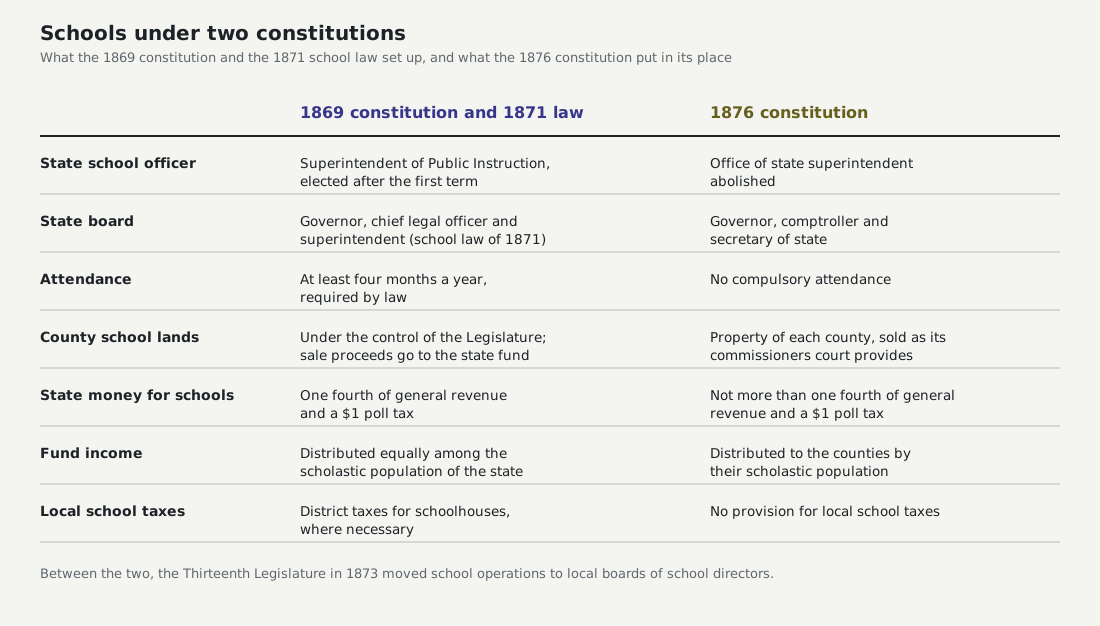
The Constitution of 1869 treated the county lands as the state’s to manage. Its article on public schools placed the lands already given to counties “under the control of the Legislature,” allowed the legislature to sell them, and sent the proceeds into the state’s Public School Fund.2 The same article created a Superintendent of Public Instruction, elected after the first term, who was to supervise the free schools and report on every one of them to each session of the legislature. It required the legislature to compel attendance for at least four months of every year, and it committed one fourth of the annual revenue from general taxation, plus a poll tax of one dollar, to the schools.2
Edmund Davis’s legislature built on that frame. The school law of 1871 created a highly centralized system: the state supported the schools in every county, selected and tested the teachers, and set a common curriculum and a graded course of study.3 A state board of education made up of the governor, the state’s chief legal officer and the superintendent oversaw it.4 Opponents objected to the cost, to compulsory attendance, to the education of Black children and to the concentration of authority, and the schools became one of the main targets of Democratic attacks on the Davis administration.3 The Thirteenth Legislature, in 1873, handed school operations to local boards of school directors and left the state superintendent mostly keeping records.3
Now lay the 1876 article beside it. It opens with a duty to support an efficient system of public free schools. Then it takes the county lands back from the state. Lands granted to the counties for schools are declared “of right the property of said counties,” with title vested in each county, to be sold as the commissioners court of the county provides, and with the proceeds held by the county in trust for its schools and only the interest spent.5 The state school fund, built from the older grants and half of the public domain, was to be invested, and its income distributed to the counties according to their scholastic population, meaning a count of school age children.5 A board of the governor, the comptroller and the secretary of state was to hand out the money.5 The same document abolished the office of state superintendent, ended compulsory attendance, required separate schools for white and Black children and made no provision for local school taxes.6
One phrase carries more than it seems to. The 1869 text said the legislature shall set apart one fourth of general revenue for schools. The 1876 text says not more than one fourth.25 A floor became a ceiling in the space of three words.
What the county got, and what it did not
So the answer to the caller was that from 1876 his county owned its school land outright and managed it through its own court, where under the 1869 constitution the legislature had controlled it. That is the most concrete thing decentralization meant on the ground. The county became the place where school land was held and sold and where the state’s school money arrived by head count, much as a registration roll like the voter registration lists of 1867 turned a population into a number the state could act on.
That clause also made one county record matter more than any other. If the state’s money arrived according to scholastic population, then the county’s count of school age children decided the county’s share. A count that decides money is a count somebody has a reason to push upward, and I read any census taken for a payment with that in mind. The caller had gone looking for deeds. The more revealing county school record of those years may be the list of children.
Here is a position that people who admire the 1871 system will resist. I think returning the lands to the counties was right, even though much of the rest of the 1876 article was a retreat. A county that owned its land had a reason to watch its sale, and a legislature in Austin had forty other things on its desk. The objection is a strong one, and the Handbook of Texas supplies it: by 1855, thirty eight counties had not even surveyed the school land they had been given.4 Local control of a fund does not guarantee local care of it, and some counties plainly did not care.
The deeper objection is to everything around the land. With no state superintendent, no compulsory attendance and no provision for local taxes, the constitution put the counties in charge of an asset and gave them little else to run a school with. Richard Coke, the subject of my biography, sat on the new three member board as governor.7 His message to the legislature in January 1875, the same one that called for a constitutional convention, wanted local school levies held to a small fraction of a percent, and in the same breath for the means to keep a protecting force in the field.8 Schools were competing for money with the cost of guarding the frontier, which the Handbook says offset the savings Coke made elsewhere.7 The convention that fixed the legislature’s sessions in Austin wrote a school article to match a government that meant to spend little.6
Where my reading breaks is exactly at the county line. The constitution tells me what a county was allowed to do. It cannot tell me what any county did. For that the caller will need the minutes of his own commissioners court and whatever record the county kept of land sold and interest collected, and those vary from one courthouse to the next. The state administration did come back in stages: the legislature restored a state superintendent in 1884, and a law of 1887 provided for a county superintendent of schools.910 The man who had been elected superintendent in December 1873, Orlando N. Hollingsworth, spent 1876 to 1884 as secretary of the state board instead.11 The title changed; the man did not.
The wider settlement of 1876 is summarized in the reference entry on the Texas Constitution of 1876, and the rest of these records are on the Reconstruction essays page.
The compromise of 1876, stated flatly, was this: the state kept the school fund and sent its income to the counties by head count, the counties got their school lands back, and no child was required to attend.
References
-
Handbook of Texas Online, Texas State Historical Association, Land Appropriations for Education. ↩ ↩2
-
Tarlton Law Library, University of Texas School of Law, Constitutions of Texas 1824 to 1876, Constitution of Texas (1869), Article IX, Public Schools. ↩ ↩2 ↩3
-
Handbook of Texas Online, Texas State Historical Association, Reconstruction. ↩ ↩2 ↩3
-
Handbook of Texas Online, Texas State Historical Association, Education. ↩ ↩2
-
Tarlton Law Library, University of Texas School of Law, Constitutions of Texas 1824 to 1876, Constitution of Texas (1876), Article VII, Education, the Public Free Schools. ↩ ↩2 ↩3 ↩4
-
Handbook of Texas Online, Texas State Historical Association, Constitution of 1876. ↩ ↩2
-
Handbook of Texas Online, Texas State Historical Association, Coke, Richard. ↩ ↩2
-
Legislative Reference Library of Texas, Session snapshot, 14th Legislature, Second Session. ↩
-
Handbook of Texas Online, Texas State Historical Association, Superintendent of Public Instruction. ↩
-
Handbook of Texas Online, Texas State Historical Association, Texas State Teachers Association. ↩
-
Handbook of Texas Online, Texas State Historical Association, Hollingsworth, Orlando Newton. ↩